


When someone asks, “How much is 6 3 in meters?” the answer looks simple, but height conversions can become oddly confusing when feet, inches, centimetres, and metres start mixing together.
A person who is 6 feet 3 inches tall is not 6.3 feet, because the inch part is not a decimal fraction of a foot. That little detail causes quite a few mistakes, honestly.
The exact answer is 6 feet 3 inches = 1.905 metres, which is usually rounded to 1.91 m. In centimetres, the same height is 190.5 cm. So, if you are filling out a form, checking a height chart, or simply curious about your height in metric units, this is the conversion you need.
6 3 in Meters: Quick Answer

The common search phrase 6 3 in meters normally means 6 feet 3 inches in meters. Using the standard conversion factors, the result is:
- 6 feet 3 inches = 1.905 metres
- Rounded to two decimal places: 1.91 m
- In centimetres: 190.5 cm
- In inches: 75 inches
- In feet as a decimal: 6.25 feet
Therefore, 6′ 3″ in meters = 1.905 m, or approximately 1.91 m. If a website or form only accepts two decimal places, entering 1.91 m is generally the appropriate rounded value.
6 Feet 3 Inches to Meters
To understand 6 feet 3 inches to meters, it helps to separate the feet and inches before converting them. A foot contains 12 inches, so 6 feet contains 72 inches. Add the additional 3 inches and the total becomes 75 inches.
Since 1 inch = 0.0254 metres, the calculation is:
75 × 0.0254 = 1.905 metres
So, 6 feet 3 inches to meters = 1.905 m. When rounded, this becomes 1.91 metres. Pretty straightforward once the feet are turned into inches first, though the wording of these conversions can make it look harder than it really is.
How to Convert 6′ 3″ in Meters
There are two useful methods for converting 6′ 3″ in meters. You can convert feet and inches separately, or turn the entire measurement into inches and then convert inches to metres.
Using the first method:
- 1 foot = 0.3048 metres
- 6 feet = 6 × 0.3048 = 1.8288 metres
- 1 inch = 0.0254 metres
- 3 inches = 3 × 0.0254 = 0.0762 metres
- 1.8288 + 0.0762 = 1.905 metres
The second method is even quicker:
- 6 feet = 72 inches
- 72 + 3 = 75 inches
- 75 × 0.0254 = 1.905 metres
Both methods arrive at the exact same answer, which is useful when checking a manual calculation.
6 ft 3 in = 1.91 m
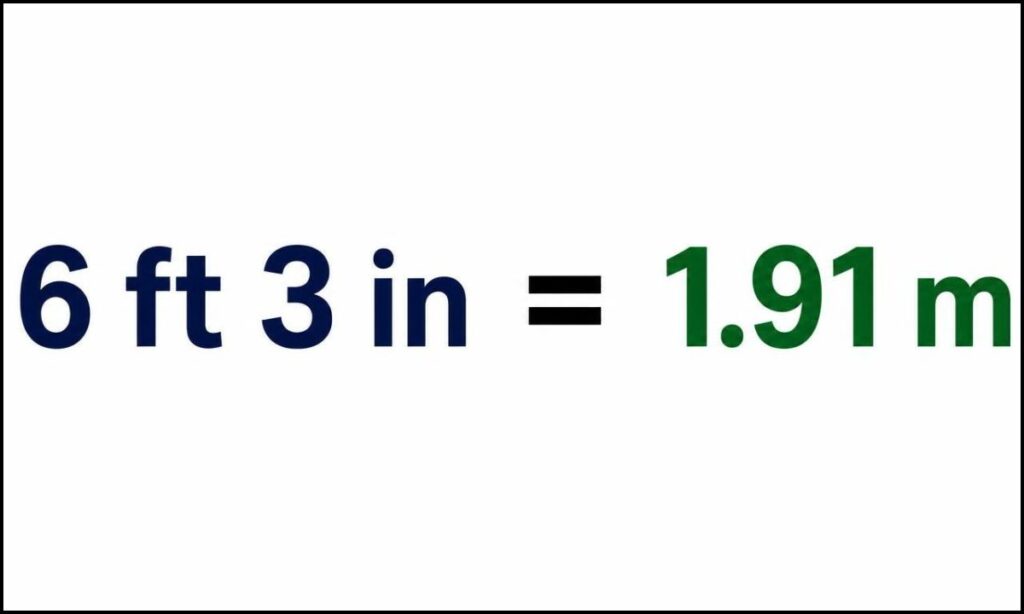
The statement 6 ft 3 in = 1.91 m is correct when the result is rounded to two decimal places. The unrounded measurement is 1.905 m.
This distinction matters when a document asks for a certain number of decimal places or significant figures. For example, 1.905 m is more precise than 1.91 m, while 1.9 m is less precise. Don’t throw away extra digits too early if the measurement needs to stay accurate.
For everyday height conversion, 1.91 m is usually easy to read and sufficiently precise. For technical work, however, keeping the original 1.905 metres may be preferable.
The Conversion Formula for 6 Feet 3 Inches
The feet to metres conversion formula is simple because one foot has an internationally defined length of exactly 0.3048 metres.
For a measurement expressed in feet and inches, use:
Metres = (feet × 0.3048) + (inches × 0.0254)
For 6 feet 3 inches:
(6 × 0.3048) + (3 × 0.0254)
= 1.8288 + 0.0762
= 1.905 m
This is the standard foot to metre conversion formula, and it can be used for practically any height expressed in feet and inches. Once you know it, the conversion becomes almost boringly easy.
Why 63 Inches Is Equal to 1.905 Meters
Another way to understand this measurement is through the relationship between feet and inches. Be careful here, because 63 inches is not the same as 6 feet 3 inches.
Six feet three inches equals:
6 × 12 + 3 = 75 inches
So:
75 inches × 0.0254 = 1.905 metres
By comparison, 63 inches equals 5 feet 3 inches, which is about 1.6002 metres. This is an important distinction because searches such as 63 inches to meters can look very similar to 6 feet 3 inches to meters, but they represent completely different heights.
1 Foot and 1 Inch in Metric Units
The entire conversion system becomes easier when you remember two basic values:
- 1 foot = 0.3048 metres
- 1 inch = 0.0254 metres
These are exact conversion relationships, not estimates. Therefore, converting feet to metres or inches to metres does not require guessing or measuring against a physical object.
You can also remember the reverse relationships:
- 1 metre = 3.2808399 feet
- 1 metre = 39.3700787 inches
These numbers are especially useful when converting from metric units back into imperial units. They may look unnecessarily long, but that’s just precision being precision.
6 3 in Meters and Centimetres

If you need height in centimetres rather than metres, simply multiply metres by 100.
For 6 feet 3 inches:
1.905 metres × 100 = 190.5 centimetres
Therefore:
6′ 3″ = 1.905 m = 190.5 cm
This can be useful because some countries and forms prefer centimetres for height. A person who is 6 feet 3 inches can therefore write 190.5 cm when a form requests height in centimetres.
The measurement does not change just because the unit changes. Only the way we describe the same physical height changes, which is the whole point of unit conversion really.
6 Feet 3 Inches to Metres Using a Height Converter
An online height converter or height conversion calculator can convert 6 feet 3 inches almost instantly. You enter 6 in the feet field and 3 in the inches field, and the calculator returns approximately 1.905 metres.
These tools are handy when you have many measurements to convert. Instead of repeatedly doing the arithmetic, a height converter can handle the calculations for you.
Still, knowing the manual method is useful. Online calculators can make life faster, but understanding the conversion formula lets you check whether the displayed result makes sense.
Height Conversion Chart
A small height conversion chart can make common measurements much easier to compare.
| Height in Feet and Inches | Metres | Centimetres |
|---|---|---|
| 3′ 0″ | 0.9144 m | 91.44 cm |
| 4′ 0″ | 1.2192 m | 121.92 cm |
| 5′ 0″ | 1.5240 m | 152.40 cm |
| 6′ 0″ | 1.8288 m | 182.88 cm |
| 6′ 3″ | 1.9050 m | 190.50 cm |
| 6′ 6″ | 1.9812 m | 198.12 cm |
| 7′ 0″ | 2.1336 m | 213.36 cm |
The row for 6′ 3″ to metres is the one most relevant here: it equals 1.905 metres. Tables like this are particularly useful when comparing several heights instead of doing each conversion from scratch.
Common Height Conversions Around 6 Feet
People often need nearby values when checking a height conversion chart. Here are a few common examples:
- 6′ 0″ = 1.8288 m
- 6′ 1″ = 1.8542 m
- 6′ 2″ = 1.8796 m
- 6′ 3″ = 1.9050 m
- 6′ 4″ = 1.9304 m
- 6′ 5″ = 1.9558 m
- 6′ 6″ = 1.9812 m
Notice that each additional inch increases the height by 0.0254 metres, or 2.54 centimetres. So a one-inch difference isn’t huge, but it does matter when precision is important.
Feet and Inches to Metres
The phrase feet and inches to metres describes a common conversion between imperial units and metric units. Feet and inches are traditionally used in countries such as the United States, while metres and centimetres are standard metric measurements.
To convert a combined measurement, convert the feet and inches separately, then add them together. This method works for height, furniture dimensions, construction measurements, and other forms of length conversion.
For example, someone measuring 6 feet 3 inches does not convert “6.3 feet.” Instead, the 3 inches must remain an inch measurement until it is properly converted. That’s one of those tiny details that saves a surprisingly large number of incorrect answers.
Imperial to Metric Height Conversion
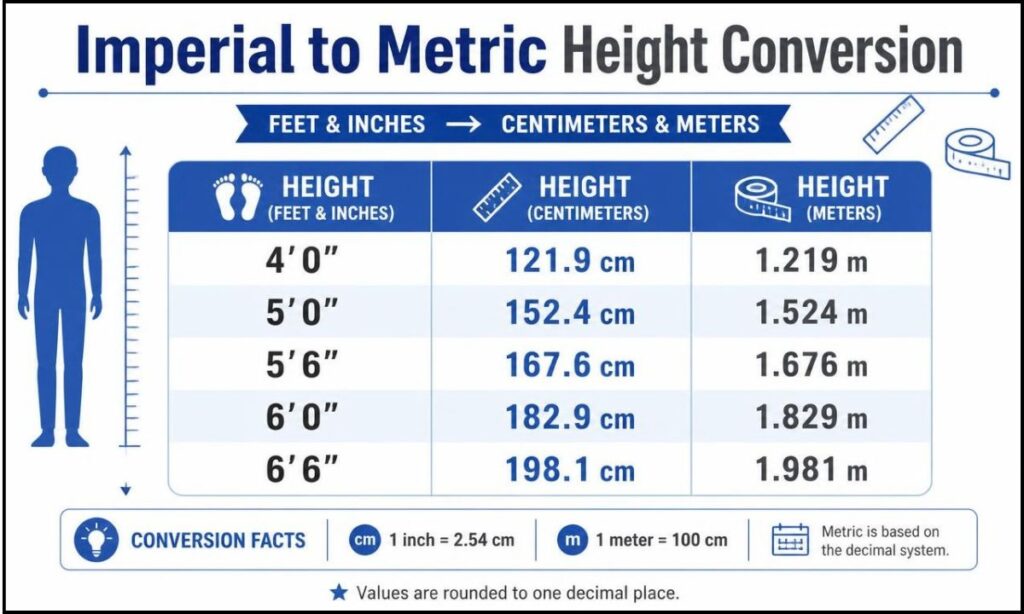
Height conversion from imperial to metric is essentially a matter of applying standard relationships. The imperial measurement may be given in feet and inches, while the metric result is generally expressed in metres or centimetres.
For example:
6 feet 3 inches → 1.905 metres → 190.5 centimetres
The reverse process is also possible. If you know a height in metres, you can convert it into feet and inches by multiplying by 3.2808399 to obtain decimal feet and then separating the whole feet from the remaining fraction.
This is why an imperial to metric height converter can be helpful for international forms, travel documents, sports records, and general comparison.
Feet to Metres Conversion Formula
The simplest feet to metres conversion formula is:
Metres = feet × 0.3048
For example:
6 × 0.3048 = 1.8288 metres
But if inches are included, they must also be converted:
Metres = (feet × 0.3048) + (inches × 0.0254)
So for 6 feet 3 inches:
(6 × 0.3048) + (3 × 0.0254) = 1.905 metres
This formula is useful far beyond one particular height. You can use it for 5 feet 8 inches, 6 feet 1 inch, 6 feet 3 inches, or practically any other human height.
Metres to Feet and Inches
Sometimes the direction goes the other way. You may have 1.905 metres and need to know the corresponding imperial measurement.
Multiply metres by 3.2808399:
1.905 × 3.2808399 ≈ 6.25 feet
The decimal 0.25 foot is equal to 3 inches because:
0.25 × 12 = 3 inches
Therefore:
1.905 metres = 6 feet 3 inches
This is the basic process used by metres to feet and inches calculators. It looks slightly more complicated than the forward conversion, mostly because decimal feet have to be changed back into inches.
Examples of Metres to Feet and Inches
A few reference points can make metric height easier to understand:
- 1.00 metre ≈ 3 feet 3.37 inches
- 1.50 metres ≈ 4 feet 11.06 inches
- 1.80 metres ≈ 5 feet 10.87 inches
- 2.00 metres ≈ 6 feet 6.74 inches
- 2.45 metres ≈ 8 feet 0.49 inches
These values are useful in a metres to feet chart or when checking the output of a metric height calculator. Rounding can vary depending on whether the result is shown to the nearest inch, centimetre, or decimal place.
The Role of the International System of Units
The International System of Units, commonly called SI, provides the internationally recognized framework for metric measurement. The metre is the SI base unit for length.
Organizations and standards associated with SI include the BIPM, which publishes the SI Brochure describing the system and its units. The use of standardized measurement helps people in different countries communicate measurements without relying on local conventions.
That is particularly useful for international engineering, science, manufacturing, transportation, and documentation. A metre in one country isn’t a slightly different metre somewhere else, thankfully.
Why the Yard Matters in Imperial Measurement
The foot and inch are related to the yard, another traditional unit of length. One yard is exactly 0.9144 metres, and it contains three feet.
This relationship means:
1 yard = 3 feet = 36 inches = 0.9144 metres
Although yards are less important for ordinary height measurements, they are useful for understanding how traditional imperial measurement relates to metric measurement.
The exact definition of these units makes imperial to metric conversion consistent rather than approximate.
Australia, Canada, New Zealand, the United Kingdom, and the United States
Different countries have different everyday measurement habits. The United States of America commonly uses feet and inches when discussing a person’s height.
In the United Kingdom, feet and inches are also widely understood for personal height, even though the country officially uses metric units in many contexts. Australia, Canada, and New Zealand have extensive use of metric measurement, so centimetres and metres may appear more often in official or everyday settings.
That mix is one reason online searches for height in meters, height in metres, and height in feet and inches are so common. People regularly need to translate between familiar systems.
Height in Metres for Forms and Documents
A height of 6 feet 3 inches may need to be entered as 1.905 m or 190.5 cm, depending on the form.
For a passport height conversion, always follow the format requested by the issuing authority rather than choosing a unit yourself. The same applies to medical forms, applications, sports registrations, and other official documents.
If a form asks for metres to two decimal places, 1.91 m is appropriate. If it asks for centimetres, enter 190.5 cm unless the form specifies a different rounding rule.
Height Measurement and Rounding
Your actual height can change slightly during the day because the spine experiences compression while you stand and move. Therefore, a measurement taken in the morning may differ a little from one taken later.
When a height measurement is converted, rounding creates another small difference. For example, the exact conversion is 1.905 metres, while two decimal places gives 1.91 metres.
For ordinary purposes, that difference is tiny. For technical applications, however, the requested significant figures or decimal places should be followed carefully.
Quick Reference for 6′ 3″
Here is the complete conversion in one place:
| Measurement | Equivalent |
|---|---|
| Feet and inches | 6′ 3″ |
| Total inches | 75 in |
| Decimal feet | 6.25 ft |
| Metres | 1.905 m |
| Rounded metres | 1.91 m |
| Centimetres | 190.5 cm |
| Millimetres | 1,905 mm |
So if you searched convert 6 feet 3 inches to meters, the answer is 1.905 metres. If you need a shorter rounded version, use 1.91 m.
Frequently Confused Measurements
One common mistake is confusing 6 3 with 6.3 feet. These are not equivalent measurements. Six feet three inches equals 6.25 feet, not 6.3 feet.
Another mistake is confusing 63 inches to meters with 6 feet 3 inches. As explained earlier, 63 inches is 5 feet 3 inches, while 6 feet 3 inches is 75 inches.
These errors happen because human height is often written in a mixed format such as 6′ 3″, while calculators prefer a single unit. Converting everything into inches first is usually the safest approach.
Why Accurate Height Conversion Matters
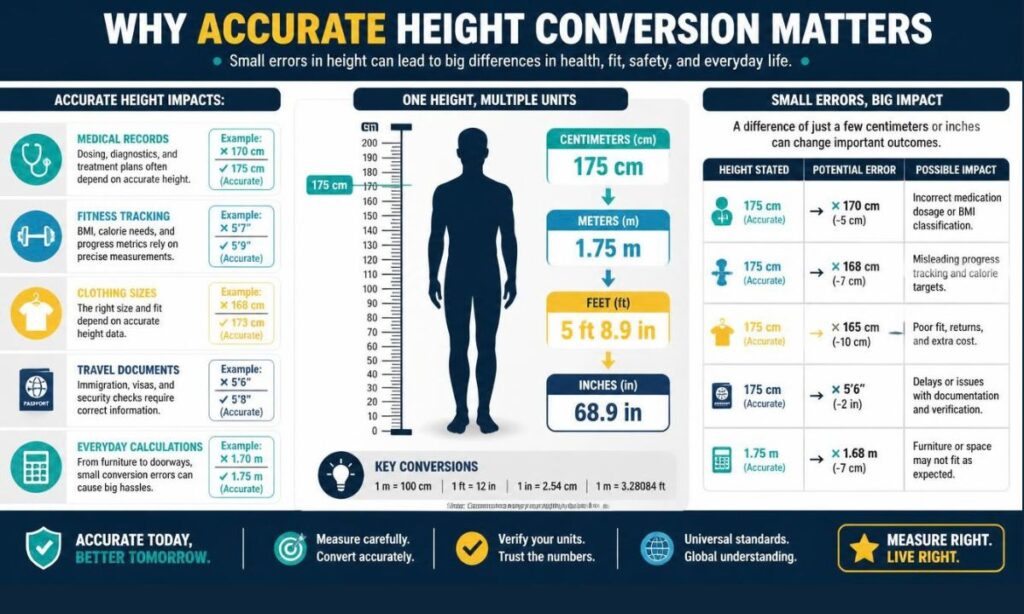
A quick height conversion may seem like a tiny task, but accurate measurements matter in many situations. Clothing and equipment sizing, sports records, medical documentation, travel forms, and international applications can all require a reliable height.
Using a standardized height conversion calculator reduces arithmetic mistakes, while knowing the underlying formula gives you a way to verify the answer.
For 6 feet 3 inches, the key figures are easy to remember:
75 inches = 1.905 metres = 190.5 centimetres.
That’s the whole conversion in three different measurement languages, so to speak.
Frequently Asked Questions
What Is 6 Feet 3 Inches in Meters?
6 feet 3 inches is equal to 1.905 meters, commonly rounded to 1.91 m.
How Do You Convert 6′ 3″ to Meters?
Convert 6 feet to 1.8288 meters and 3 inches to 0.0762 meters, then add them to get 1.905 meters.
How Many Centimeters Is 6 Feet 3 Inches?
A height of 6 feet 3 inches equals 190.5 centimeters, which is the same as 1.905 meters.
Is 6 Feet 3 Inches the Same as 63 Inches?
No. 6 feet 3 inches equals 75 inches, while 63 inches equals 5 feet 3 inches.
Conclusion
If you were looking for 6 3 in meters, the direct answer is 1.905 metres, commonly rounded to 1.91 m. The same height is 190.5 cm, 75 inches, or 6.25 feet.
The conversion works because 1 foot = 0.3048 metres and 1 inch = 0.0254 metres. Using those exact relationships, 6 feet 3 inches to metres can be calculated without relying on an approximate chart or guess.
Whether you’re using a height converter, completing a form, comparing metric and imperial measurements, or simply checking 6′ 3″ in meters, remember that the inch portion should never be treated as a decimal part of a foot. Convert the units properly, keep the desired decimal places, and the answer stays nice and clear.
For quick reference, keep this one nearby:
6′ 3″ = 75 inches = 1.905 metres = 190.5 cm ≈ 1.91 m.
A small conversion, yes, but once the unit system changes, that little number can suddenly become surprisingly useful.
