


Sometimes a measurement looks tiny on paper, but getting it exactly right can matter quite a lot. 1 inch 7/8 is one of those measurements that appears often in tools, hardware, model making, woodworking, pipes, screws, and other technical work.
If you are trying to convert 1 7/8 inches into millimeters, the answer is 47.625 mm. Yep, it is that straightforward once the fraction is understood correctly.
The measurement 1 7/8 inches is the same as 1.875 inches, and because one inch equals exactly 25.4 millimeters, the conversion can be worked out without guessing.
This page explains the calculation, the decimal and fractional forms, useful metric equivalents, and where this particular size may show up in everyday or technical situations. A little conversion knowledge can save a surprising amount of head-scratching when working between measurement systems.
1 Inch 7/8 to mm: Quick Answer
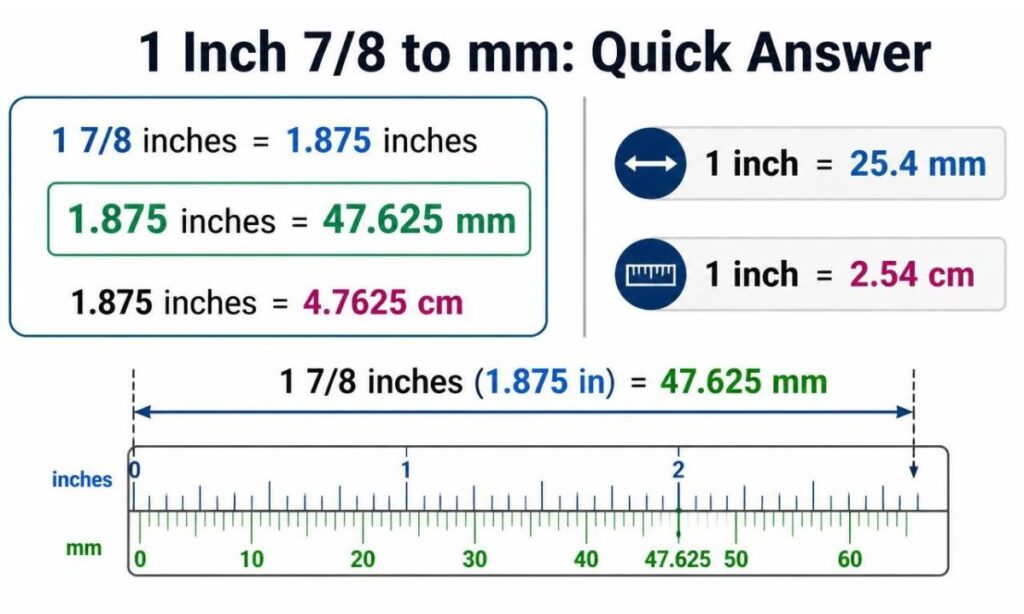
The direct answer is simple: 1 inch 7/8 to mm = 47.625 mm. The fraction 7/8 means seven parts out of eight, so the complete measurement is one full inch plus seven-eighths of another inch. It sounds slightly old-school, but fractional inches are still common in hardware and workshop measurements.
Here is the basic conversion:
- 1 7/8 inches = 1.875 inches
- 1.875 inches = 47.625 mm
- 1.875 inches = 4.7625 cm
- 1 inch = 25.4 mm
- 1 inch = 2.54 cm
So, if a ruler, tool specification, drawing, or product description says 1 7/8 in, its exact metric equivalent is 47.625 mm. In many practical situations, you may see this rounded to 47.6 mm or even 48 mm, but those rounded values are not the exact conversion.
How to Convert 1 7/8 Inches to Millimeters
The easiest way to understand the conversion is to first change the fraction into a decimal. Seven divided by eight equals 0.875, and adding the one whole inch gives 1.875 inches. From there, the standard inch-to-millimeter conversion becomes very easy.
The core rule is:
1 inch = 25.4 millimeters
Now multiply:
1.875 × 25.4 = 47.625 mm
That means 1 7/8 inches to millimeters is exactly 47.625 mm. Nothing mysterious is happening here, although fractional measurements can look a little intimidating if you’re used to working only with decimal numbers.
The same measurement can also be expressed in centimeters. Since one inch equals 2.54 centimeters, the calculation is:
1.875 × 2.54 = 4.7625 cm
Therefore:
1 7/8 in = 1.875 in = 47.625 mm = 4.7625 cm
1 7/8 Inches to Millimeters Conversion Table
A small conversion table is useful when you are checking a measurement quickly instead of doing the same calculation again and again. The exact result is shown below, along with its decimal and centimeter forms.
| Measurement | Decimal Inches | Millimeters | Centimeters |
|---|---|---|---|
| 1 7/8 in | 1.875 in | 47.625 mm | 4.7625 cm |
| 1 1/2 in | 1.5 in | 38.1 mm | 3.81 cm |
| 1 5/8 in | 1.625 in | 41.275 mm | 4.1275 cm |
| 1 3/4 in | 1.75 in | 44.45 mm | 4.445 cm |
| 1 7/8 in | 1.875 in | 47.625 mm | 4.7625 cm |
| 2 in | 2.0 in | 50.8 mm | 5.08 cm |
This makes it easier to see where 1 7/8 inches sits among common fractional inch sizes. It is only 1/8 inch smaller than 2 inches, which equals 50.8 mm, so the difference is 3.175 mm.
Understanding 1.875 Inches
The decimal form 1.875 inches is simply another way of writing 1 7/8 inches. When converting between the inch system and the metric system, changing fractions into decimals can make calculations much quicker.
To convert the fraction:
7 ÷ 8 = 0.875
Then:
1 + 0.875 = 1.875
So:
1 7/8 = 1.875 inches
From there:
1.875 × 25.4 = 47.625 mm
Decimal inches are especially handy when entering a measurement into a digital conversion calculator, CAD program, spreadsheet, or online converter. Still, many physical tools and hardware products continue to display fractional inches, so knowing both formats is useful.
Why 1 7/8 Inches Equals 47.625 mm
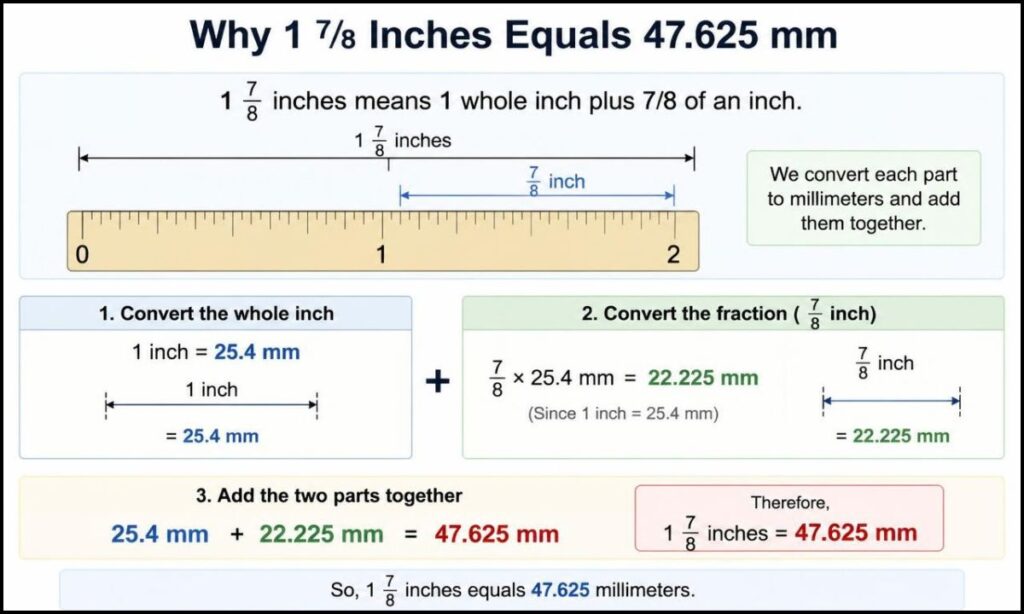
The relationship between inches and millimeters is fixed. One inch is defined as exactly 25.4 millimeters, meaning there is no estimation involved in the basic conversion. That’s why the answer remains consistent whether you calculate it manually or use a digital converter.
For 1 7/8 inches, the calculation can also be separated into two parts:
- 1 inch = 25.4 mm
- 7/8 inch = 22.225 mm
- 25.4 + 22.225 = 47.625 mm
The fraction itself can be converted like this:
7/8 × 25.4 = 22.225 mm
Then the full measurement is:
25.4 + 22.225 = 47.625 mm
This method is pretty useful when you want to understand where the number comes from, rather than simply trusting a calculator result.
Fractional Inches and Their Metric Equivalents
Fractional measurements are common in the traditional Anglo-Saxon measurement system, especially in the United States and in certain technical and workshop environments. Measurements such as 1/4, 3/8, 1/2, 5/8, 3/4, and 7/8 inch can appear on tools, fasteners, drawings, and materials.
Here are several common metric equivalents:
| Fractional Inch | Decimal Inch | Millimeters |
|---|---|---|
| 1/8 in | 0.125 | 3.175 mm |
| 1/4 in | 0.25 | 6.35 mm |
| 3/8 in | 0.375 | 9.525 mm |
| 1/2 in | 0.5 | 12.7 mm |
| 5/8 in | 0.625 | 15.875 mm |
| 3/4 in | 0.75 | 19.05 mm |
| 7/8 in | 0.875 | 22.225 mm |
| 1 in | 1.0 | 25.4 mm |
| 1 1/8 in | 1.125 | 28.575 mm |
| 1 1/2 in | 1.5 | 38.1 mm |
| 1 7/8 in | 1.875 | 47.625 mm |
| 2 in | 2.0 | 50.8 mm |
The numbers become easier to remember after seeing the pattern a few times. Every additional inch adds another 25.4 mm, while each eighth of an inch represents 3.175 mm.
Inch → Metric Conversion Explained
The Inch → Metric direction means converting an inch-based measurement into millimeters or centimeters. For millimeters, multiply the inch value by 25.4. For centimeters, multiply it by 2.54.
For example:
1.875 inches × 25.4 = 47.625 mm
And:
1.875 inches × 2.54 = 4.7625 cm
This type of metric conversion is frequently needed when an American or older specification has to be used with metric equipment. A drawing may list dimensions in inches while the workshop ruler or digital measuring tool displays millimeters. It happens more often than you might expect.
Metric → Inch Conversion
The reverse process, Metric → Inch, is just as straightforward. Instead of multiplying by 25.4, divide the millimeter measurement by 25.4.
For example:
47.625 mm ÷ 25.4 = 1.875 inches
Then, if you want the fractional inch equivalent:
1.875 inches = 1 7/8 inches
This is particularly useful when a measurement is taken with a metric caliper but needs to be compared with an inch-based specification. The reverse conversion can look slightly more awkward, but the same basic relationship always applies.
Where Is 1 7/8 Inches Used?
A measurement of 1 7/8 inches can appear in many technical fields. It may be used for the dimensions of hardware, openings, components, tools, or materials, depending on the particular industry and specification.
For example, you might encounter the size while checking:
- Tools and precision tools
- Screws and fasteners
- Pipes and fittings
- Mechanical components
- Threads and hardware
- Woodworking materials
- Model making
- Precision mechanics
- Workshop equipment
- Technical drawings
It is important not to assume that a dimension marked 1 7/8 inches automatically identifies a particular screw, pipe, or thread size. Nominal sizing varies by product and industry, so the actual specification should always be checked before purchasing or machining something. Measurements love to be simple until a product catalogue gets involved, honestly.
1 7/8 Inch Measurement in Precision Work
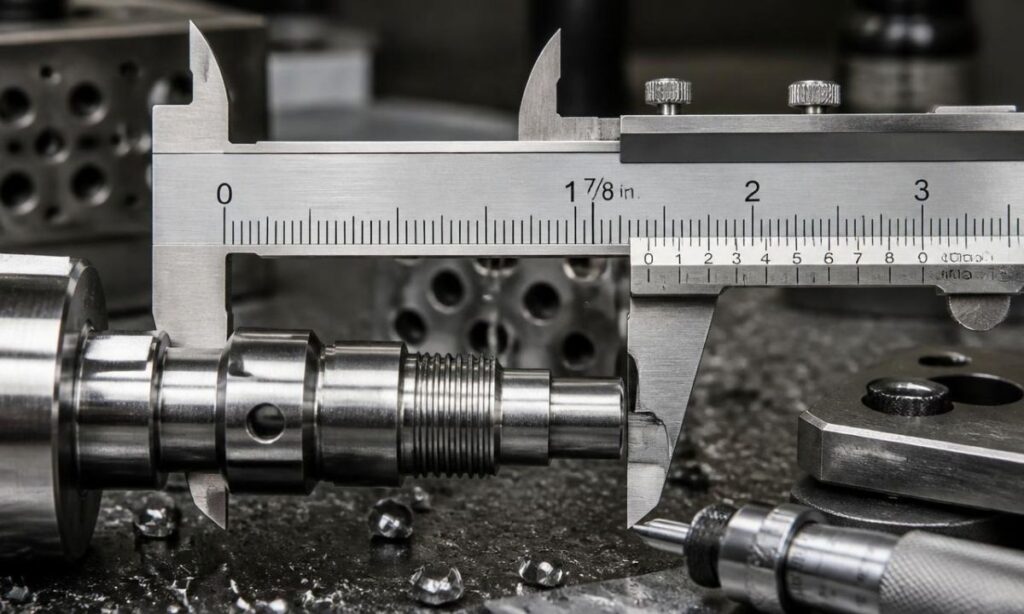
In precision measurement, even a small difference can matter. The difference between 47.625 mm and 48 mm is only 0.375 mm, but that may be significant in precision mechanics or when two parts must fit together closely.
For ordinary household work, rounding 47.625 mm to 48 mm may be perfectly reasonable. For machining, engineering, model making, or precision tools, however, the required tolerance should determine how many decimal places are retained.
That is why the exact answer is worth remembering:
1 7/8 inches = 47.625 mm
The rounded answer should only be used when the application allows it. A ruler measurement for a quick DIY project is not the same thing as a precision-machined component, and mixing those two situations can create needless problems.
1 7/8 Inches on a Tape Measure
If you are using a traditional tape measure, you may see 1 7/8 inches represented by the mark just before the 2-inch line. Most standard inch rulers divide each inch into smaller fractions, often sixteenths or thirty-seconds.
Since 7/8 equals 14/16, the same measurement can also be written as:
1 14/16 inches
That can be useful when reading a ruler marked in sixteenths. On a typical tape measure, the measurement is located fourteen sixteenth-inch divisions after the 1-inch mark. It’s a small visual detail, but it helps when you’re trying to locate the exact line quickly.
1.875 Inch in mm: A Fast Reference
If your search starts with 1.875 inches to mm, there is no need to convert the number into a fraction first. Simply multiply the decimal value by 25.4.
1.875 × 25.4 = 47.625 mm
So the quick reference is:
| Query | Exact Result |
|---|---|
| 1.875 inch in mm | 47.625 mm |
| 1 7/8 inches to mm | 47.625 mm |
| 1 7/8 inch to millimeters | 47.625 mm |
| 1.875 inches to centimeters | 4.7625 cm |
| 47.625 mm to inches | 1.875 inches |
These equivalent forms are useful because different websites, tools, manuals, and product specifications may use different notation. One may say 1.875 in, while another writes 1 7/8″. Both describe the same length.
The Meaning of ” and in
You may see an inch measurement written as 1 7/8″ rather than 1 7/8 in. The quotation mark (") is a commonly used symbol for inches, while in is the standard abbreviation used in many technical contexts.
Therefore:
1 7/8″ = 1 7/8 in = 1.875 in
All three refer to the same measurement. This is worth knowing when searching product specifications because manufacturers don’t always write dimensions in exactly the same style.
The symbol should not be confused with a quotation mark in ordinary writing, even though it looks the same. In a measurement context, its meaning is inches.
Using an Inches to Millimeters Converter
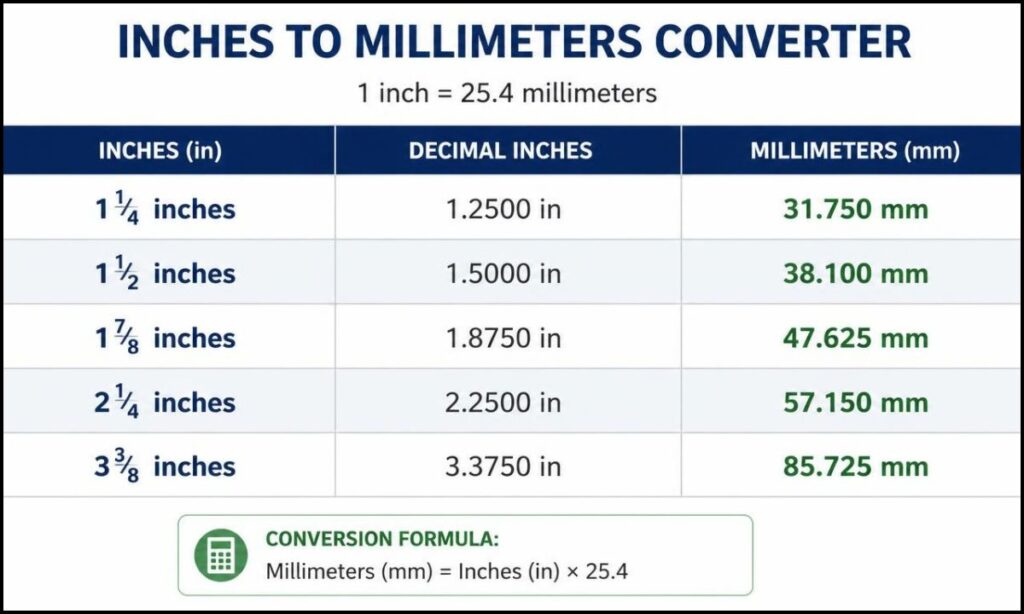
An inches to millimeters converter is convenient when you have many measurements to convert. Instead of manually multiplying every value by 25.4, you enter the inch measurement and let the tool produce the metric result.
For a single measurement such as 1 7/8 inches, though, the manual calculation is so short that a calculator isn’t really necessary. Still, an inch to metric converter becomes handy when working through a long list of dimensions.
For example, if a project contains:
- 1 1/4 inches
- 1 1/2 inches
- 1 7/8 inches
- 2 1/4 inches
- 3 3/8 inches
A converter can quickly produce the corresponding millimeter values. Just remember to check whether the tool is displaying rounded results or exact decimal values, because that small setting can matter in technical work.
Inches, Millimeters, and Centimeters Together
Knowing all three common forms makes measurements much easier to compare. The relationship is:
1 inch = 25.4 mm = 2.54 cm
Therefore:
1 7/8 inches = 1.875 inches = 47.625 mm = 4.7625 cm
This is the complete inches mm cm conversion table entry you need for this measurement. If someone gives you the value in centimeters, you can work backwards too:
4.7625 cm ÷ 2.54 = 1.875 inches
And:
4.7625 cm × 10 = 47.625 mm
The metric system itself makes the last step especially easy because 1 centimeter contains exactly 10 millimeters. Nice little bit of simplicity there.
Why Exact Conversion Matters for Tools and Materials
Suppose you are checking the size of a component before ordering replacement tools, screws, pipes, or other materials. A rough conversion may lead you toward the wrong size, particularly when several nearby measurements exist.
For example, 47.625 mm and 48 mm are extremely close, but they are not identical. If a component requires a precise fit, that difference may matter. For a casual measurement, however, rounding could be completely acceptable.
The right amount of precision depends on the job. Precision measurement is not about keeping every decimal forever; it’s about keeping enough accuracy for the purpose. That distinction saves time and avoids unnecessary complexity.
Common Mistakes When Converting 1 7/8 Inches
One common mistake is reading 1 7/8 as 1.7 or 1.78. Fractions don’t work that way. The 7/8 portion must first be calculated as 0.875, giving 1.875 inches.
Another mistake is multiplying the fraction by the wrong conversion factor. The correct relationship is 1 inch = 25.4 millimeters, not 25 or 2.54 when the desired result is in millimeters.
A third mistake is confusing an exact value with a rounded value. 47.625 mm is exact, while 47.6 mm and 48 mm are rounded representations. Both may be useful, but they aren’t interchangeable in every situation.
Quick Facts About 1 7/8 Inches
For anyone who just wants the important information without wandering through the whole measurement universe, here is the short version:
- Fraction: 1 7/8 inch
- Decimal: 1.875 inches
- Millimeters: 47.625 mm
- Centimeters: 4.7625 cm
- Inch conversion factor: 25.4 mm
- Centimeter conversion factor: 2.54 cm
- Equivalent notation: 1 7/8″, 1 7/8 in, 1.875 in
- Nearest whole millimeter: 48 mm
- 7/8 inch alone: 22.225 mm
If you are looking for the answer to convert 1 7/8 inches to mm, the number to keep in mind is simply 47.625 mm. That’s the one doing all the heavy lifting here.
Practical Example: Converting a Workshop Measurement
Imagine a workshop drawing says that a component should be 1 7/8 inches wide. Your digital caliper and machining notes are set up in millimeters, so you need the metric value.
Start with:
1 7/8 inches
Convert the fraction:
1 7/8 = 1.875 inches
Apply the conversion:
1.875 × 25.4 = 47.625 mm
The required dimension is therefore 47.625 mm. If the project allows whole-millimeter rounding, you might record it as approximately 48 mm, but if the drawing calls for exact dimensional accuracy, retain the original 47.625 mm value.
This simple example shows why knowing both fractional and decimal forms is useful in real work. A measurement isn’t merely a number; the required precision and application matter too.
About Inch and Metric Measurement Systems
The inch system has been used widely in the United States and historically across Britain and other regions, while the metric system is now the dominant measurement system in most countries. This is why international technical work sometimes feels like two rulers are having a disagreement.
The Anglo-American measurement tradition continues to appear in many products, specifications, tools, and construction materials. At the same time, engineers, manufacturers, and scientists frequently use millimeters and centimeters.
Being comfortable with both systems makes technical information easier to interpret. A person may buy a tool labeled in inches, measure the part in millimeters, and then need to check a specification written in centimeters. The ability to move between systems is genuinely useful.
Frequently Asked Questions
What Is 1 Inch 7/8 in Millimeters?
1 Inch 7/8 is equal to 47.625 mm, or approximately 48 mm when rounded to the nearest whole millimeter.
How Do You Convert 1 7/8 Inches to mm?
Convert 1 7/8 to 1.875 inches, then multiply by 25.4 to get 47.625 mm.
Is 1.875 Inches the Same as 1 7/8 Inches?
Yes, 1.875 inches and 1 7/8 inches represent exactly the same measurement in decimal and fractional form.
How Many Centimeters Is 1 Inch 7/8?
1 Inch 7/8 equals 4.7625 cm, because 1 inch is equal to 2.54 centimeters.
Conclusion
To wrap everything up, 1 inch 7/8 is equal to 1.875 inches, and that converts to exactly 47.625 millimeters.
The complete equivalence is:
1 7/8 inches = 1.875 inches = 47.625 mm = 4.7625 cm
The key formula is always:
inches × 25.4 = millimeters
So:
1.875 × 25.4 = 47.625 mm
Whether you are checking a ruler, comparing inch sizes, working with screws or pipes, doing model making, or handling precision mechanics, this conversion gives you a reliable starting point. And when the job doesn’t require extreme precision, remembering that 1 7/8 inches is approximately 48 mm can make quick estimates much easier.
The exact metric equivalent, however, remains 47.625 mm. Keep that number handy and the next time 1 7/8 inches appears on a drawing or tool specification, it won’t need to look like some mysterious workshop code anymore.
