

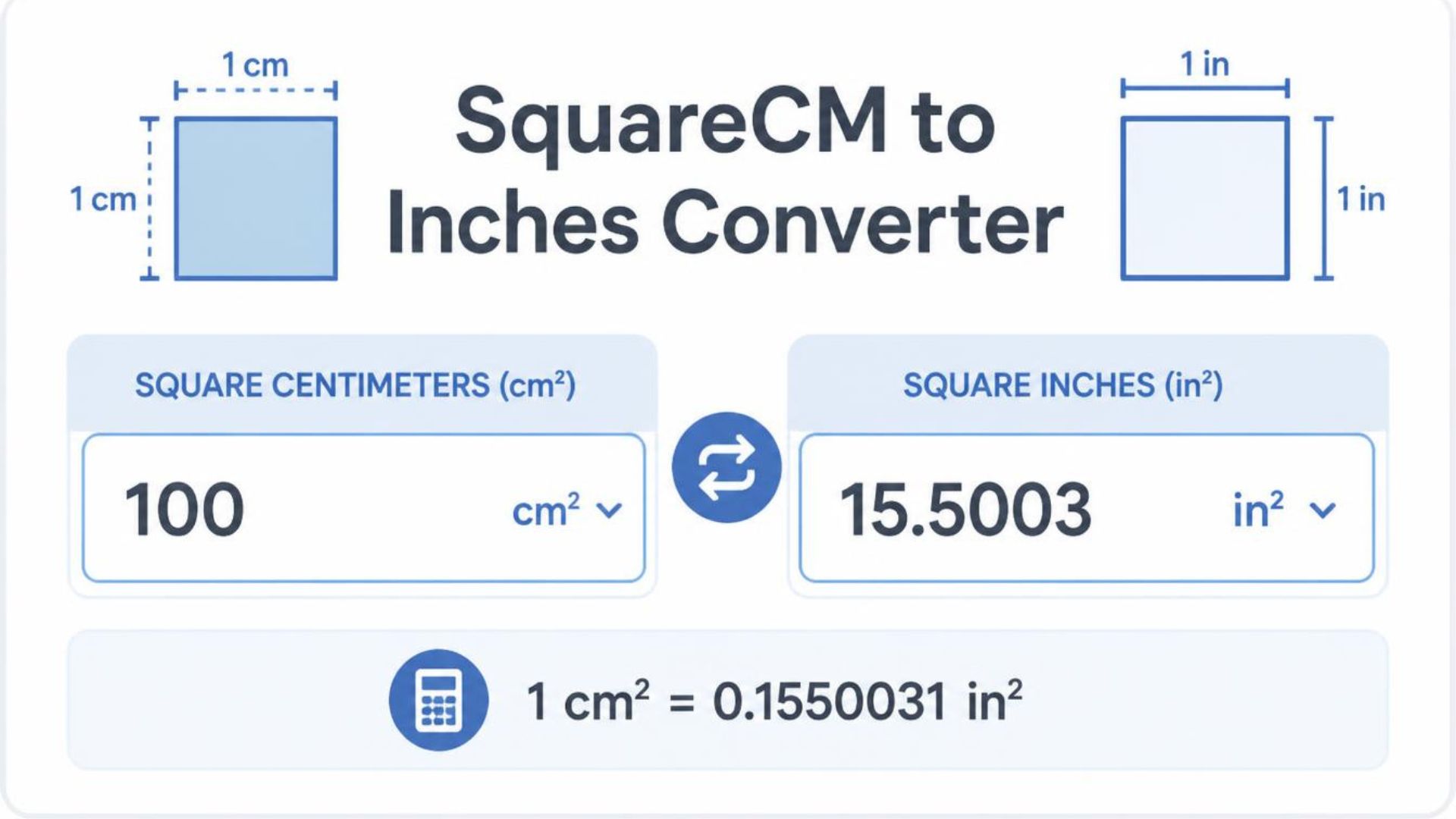
A measurement can look perfectly ordinary until you need to use it somewhere that speaks a different measurement language. A shirt label says 42 cm, a screen specification gives 16 inches, or a woodworking plan suddenly throws an unfamiliar number at you and there you are, doing tiny maths in your head.
This is exactly where a CM to Inches Converter becomes handy, because nobody really wants to wrestle with decimals before breakfast, honestly.
The Centimeter and Inch are both familiar measurement units, but they belong to different measurement traditions. Centimeters (CM) are part of the metric system, while Inches (IN) are commonly used in the imperial system and US customary measurements. Knowing how these units relate makes length conversion much less mysterious, even if the decimal numbers look a bit unfriendly at first.
Whether you need to convert cm to inches, check a product dimension, understand a technical specification, or perform a quick school calculation, the relationship between the two units stays constant. Once you know the conversion factor, the whole thing becomes rather simple almost suspiciously simple.
What Is a CM to Inches Converter?
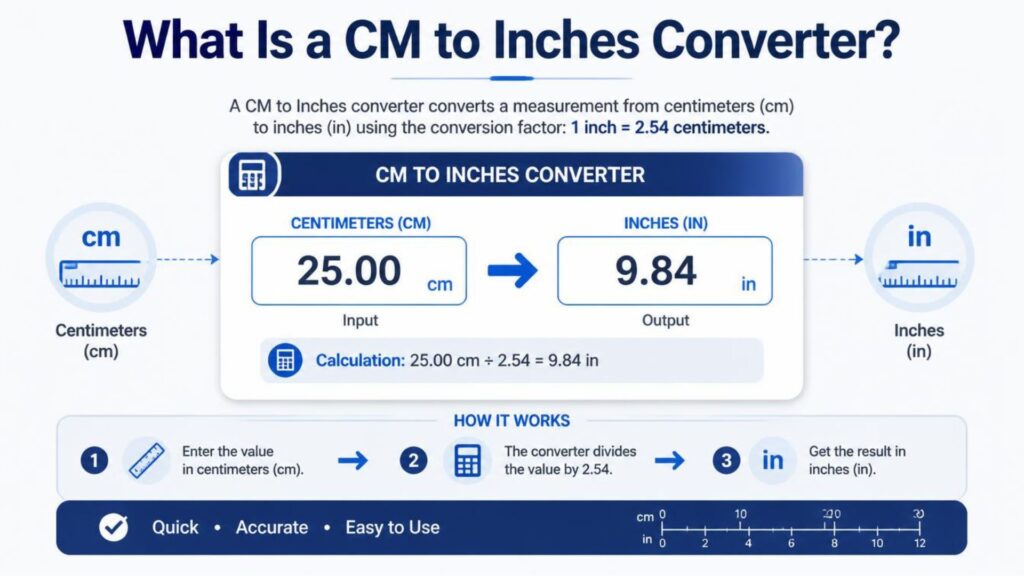
A CM to Inches Converter is a tool that changes a measurement expressed in centimeters into an equivalent measurement in inches. It performs a basic unit conversion while keeping the actual physical length exactly the same, which is the important bit people sometimes forget.
For example, if something measures 10 cm, converting it doesn’t make the object shorter or longer. It simply tells you what that same length would be when expressed using Inches instead of CM. Think of it as changing the language of the measurement, not the measurement itself.
A conversion calculator can do this instantly, while a formula can be used when you want to understand or verify the calculation yourself. Both approaches are useful, depending on whether you’re in a hurry or feeling mathematically adventurous.
Centimeters and Inches: Understanding the Two Units
A Centimeter (cm) is a metric unit of length equal to one-hundredth of a meter. Since one meter contains 100 centimeters, the centimeter fits neatly into the decimal structure of the Metric system. That makes metric measurements especially convenient for many everyday and scientific applications, though the world still enjoys mixing systems just to keep everyone humble.
An Inch (in) is another unit of length, widely used in the US customary system and also encountered in imperial measurements. Inches appear frequently in measurements for screens, clothing, construction materials, tools, paper sizes, and many household products. So yes, that little “in” can show up in rather more places than you’d expect.
The key relationship is simple: 1 inch = 2.54 centimeters. Turn that relationship around and you get 1 centimeter = 0.39370079 inches, with the longer decimal representation commonly written as 1 cm = 0.3937007874 in. The difference between those displayed values is simply a matter of rounding.
The CM to Inches Conversion Formula
If you want to calculate cm to inches manually, the main conversion formula is:
Inches = Centimeters × 0.3937007874
The number 0.3937007874 is the conversion factor used to change centimeters into inches. For most everyday calculations, using 0.39370079 inches per centimeter gives a sufficiently precise result, and your calculator won’t complain about the tiny rounding difference.
So, for example, to convert 5 cm into inches, multiply 5 by 0.3937007874. The result is approximately 1.9685 inches. That’s the entire calculation; there isn’t a secret second step hiding behind the curtain somewhere.
The reverse relationship is equally useful. To perform in to cm conversion, use:
Centimeters = Inches × 2.54
This works because there are exactly 2.54 cm per inch. Therefore, if you’re moving from inches to centimeters, multiplication by 2.54 is the straightforward route.
Why Is 1 Centimeter Equal to 0.39370079 Inches?
The reason behind the number becomes clearer when you start with the exact relationship 1 inch = 2.54 cm. To find the value of one centimeter in inches, divide 1 by 2.54. The resulting value is approximately 0.3937007874 inches, which is often shortened to 0.39370079 in for practical use.
In other words:
1 cm = 1 ÷ 2.54 inches
1 cm ≈ 0.3937007874 in
This is a useful example of dimensional analysis, where the units are deliberately tracked during a calculation so you don’t accidentally end up converting the wrong thing. It may sound grand for such a tiny calculation, but unit cancellation really does save headaches.
How to Convert CM to Inches Step by Step
Learning how to convert cm to inches is useful when you don’t have a calculator or want to check an online result. The process uses simple algebraic steps, and there are only a few of them.
Suppose you have a length of 25 cm. Start with the known measurement and multiply it by the conversion factor:
25 cm × 0.3937007874 in/cm
The “cm” units cancel, leaving the answer in inches. The result is approximately 9.8425 inches. Nice and tidy, despite the rather untidy decimal in the middle.
For a more compact step-by-step conversion, remember this pattern:
- Start with the measurement in centimeters.
- Multiply the number by 0.3937007874.
- Cancel the centimeter unit through dimensional analysis.
- Round the result to the number of decimal places you actually need.
- Write the final measurement in inches.
This is essentially algebraic conversion with a unit ratio attached. Nothing fancy, just multiplication doing its quiet little job.
CM to Inches Conversion Table
Sometimes a formula is unnecessary because you simply need a quick lookup table. The following conversion table gives several common lengths without requiring you to repeat the calculation every time.
| Centimeters (CM) | Inches (IN) |
|---|---|
| 1 cm | 0.3937 in |
| 2 cm | 0.7874 in |
| 3 cm | 1.1811 in |
| 4 cm | 1.5748 in |
| 5 cm | 1.9685 in |
| 10 cm | 3.9370 in |
| 15 cm | 5.9055 in |
| 20 cm | 7.8740 in |
| 25 cm | 9.8425 in |
| 30 cm | 11.8110 in |
| 40 cm | 15.7480 in |
| 50 cm | 19.6850 in |
| 60 cm | 23.6220 in |
| 70 cm | 27.5591 in |
| 80 cm | 31.4961 in |
| 90 cm | 35.4331 in |
| 100 cm | 39.3701 in |
This table covers the especially useful 1–100 cm conversion range, although it doesn’t list every single centimeter value. For an exact value that isn’t shown, simply use the cm to inches calculator method or the formula above.
1 to 100 CM in Inches
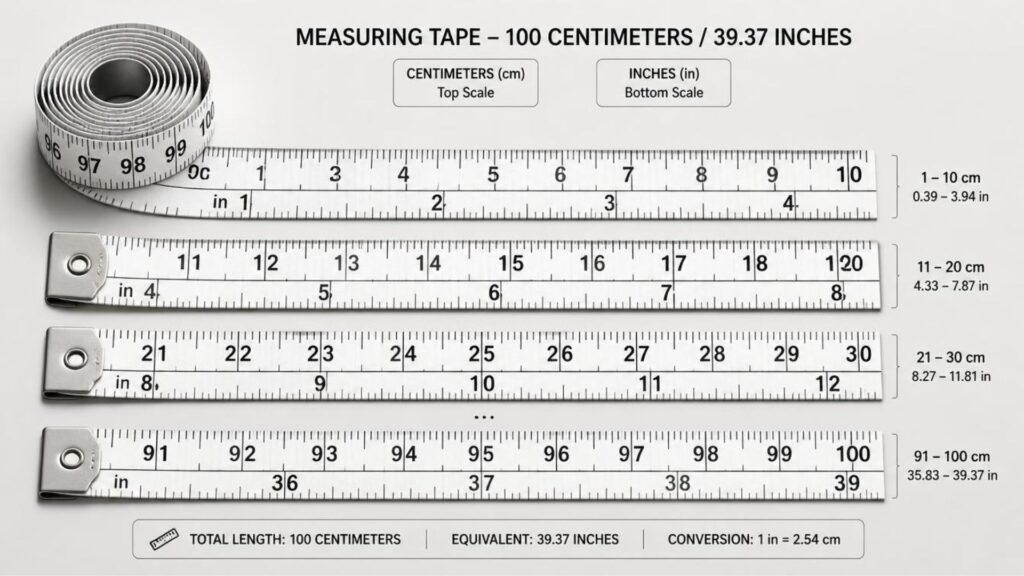
People often search for 1 to 100 cm in inches because this range covers many ordinary length measurements. A 1 cm object is quite small, while 100 cm is exactly 1 meter, giving a useful span for comparing everyday dimensions.
Here are some additional reference points from the range:
- 1 cm = 0.3937 inches
- 10 cm = 3.9370 inches
- 20 cm = 7.8740 inches
- 30 cm = 11.8110 inches
- 40 cm = 15.7480 inches
- 50 cm = 19.6850 inches
- 75 cm = 29.5276 inches
- 100 cm = 39.3701 inches
If you need every value from 1 through 100, a dedicated centimeters to inches chart can be more convenient than repeatedly entering numbers into a calculator. Still, knowing the formula means you are never really stuck without the chart, which is a nice little advantage.
Common CM to Inch Conversions
Certain values appear again and again in product specifications, crafts, clothing, home projects, and educational exercises. Having these common cm to inch conversions nearby can save a surprising amount of time.
For instance, 2.54 cm is exactly 1 inch, while 5.08 cm equals exactly 2 inches. Likewise, 7.62 cm corresponds to 3 inches, and 10.16 cm corresponds to 4 inches. These values are especially easy to remember because they are direct multiples of the 2.54 conversion factor.
A few useful examples include:
- 2.54 cm = 1 inch
- 5.08 cm = 2 inches
- 7.62 cm = 3 inches
- 10.16 cm = 4 inches
- 12.70 cm = 5 inches
- 25.40 cm = 10 inches
- 50.80 cm = 20 inches
- 76.20 cm = 30 inches
When precision matters, keep more decimal places during the calculation and round only at the end. Premature rounding is one of those tiny mathematical habits that can quietly create larger errors later.
CM to Inches Calculator: Why Use One?
A CM to inches calculator is useful when you need an answer quickly and don’t particularly want to perform multiplication manually. Enter the centimeter value, apply the conversion, and the result appears in inches almost immediately, which is exactly the sort of small convenience technology was invented for.
A calculator is especially useful when the input contains decimals, such as 12.7 cm, 34.6 cm, or 82.35 cm. Doing those calculations mentally is possible, sure, but there is no trophy waiting at the end for making your life harder.
The same principle applies to an inches calculator, centimeters calculator, unit converter, or general measurement converter. These tools are simply different interfaces for the same mathematical relationship.
CM to Inches vs. Inches to CM

The two conversions are opposites, but they use different operations. For cm → inches, multiply by approximately 0.3937007874. For inches → cm, multiply by 2.54.
This gives us the two central equations:
cm → inches:
Centimeters × 0.3937007874 = Inches
inches → cm:
Inches × 2.54 = Centimeters
It can be tempting to divide by 2.54 when converting centimeters to inches, and technically that works too, because multiplying by 0.3937007874 is equivalent to dividing by 2.54. Still, the multiplication formula is usually easier to remember.
Metric System vs. Imperial System
The need for metric to imperial conversion comes from the fact that different regions and industries use different systems. The metric system organizes length around units such as millimeters, Centimeters, Meters, and Kilometers, while imperial or US customary measurements commonly use inches, feet, yards, and miles.
The systems aren’t competitors in a boxing match, thankfully. They simply provide different ways to express the same physical quantities. A length remains a length whether you call it 100 cm or 39.3701 inches.
The same idea extends to other length units, including Feet, Yards, Miles, and Nautical miles. Larger or more specialized units include Fathoms, Rods, Furlongs, Cables, and Leagues, while scientific scales can involve Angstroms, Light-years, and Parsecs. They all describe length, but at wildly different scales rather like measuring a postage stamp and then deciding to measure the galaxy with the same ruler.
How CM Relates to Other Length Units
A centimeter is closely connected to the meter because 1 cm = 0.01 meters. Since one kilometer contains 1,000 meters, one centimeter is also 0.00001 kilometers.
At the smaller scientific scale, 1 cm equals 100,000,000 Angstroms. That’s a huge-looking number, but Angstroms are tiny units, so the comparison makes sense once the scale is understood.
A centimeter can also be expressed as approximately 0.03280839895 feet, 0.01093613298 yards, and 0.000006213711922 miles. These numbers are useful for software, engineering, and detailed measurement conversion, although most everyday users thankfully won’t need all those decimal places.
For extremely large scientific distances, the relationship becomes even more dramatic. One centimeter corresponds to roughly 3.24077885e-19 parsecs and 1.056998307e-18 light-years. It is a slightly ridiculous comparison in everyday life, but mathematically it shows that a unit conversion can connect scales far beyond ordinary measuring tape.
Using Dimensional Analysis for CM to Inches
Dimensional analysis provides a reliable way to check whether your conversion equation makes sense. Instead of treating the numbers as floating around independently, you attach their units to the calculation.
For example:
10 cm × (1 inch / 2.54 cm)
The centimeters cancel:
10 cm × (1 in / 2.54 cm) = 3.937 inches
What’s left is inches, so the calculation has produced the intended unit of length. This technique becomes particularly useful when you’re working with several conversions in a row, where a small unit mistake can otherwise sneak in wearing an innocent-looking hat.
The beauty of unit cancellation is that it works beyond cm to in conversion. The same reasoning can be applied to meters, kilometers, feet, yards, miles, and many other measurement units.
Why Precision and Rounding Matter
A conversion can be mathematically correct while still being displayed at an inconvenient level of precision. For example, saying 1 cm = 0.3937007874 inches is more precise than most household situations require, while 1 cm ≈ 0.39 inches may be perfectly adequate for a rough estimate.
The appropriate number of decimal places depends on the purpose of the measurement. Engineering, manufacturing, scientific work, and technical drawings may require greater precision, while casual shopping or a rough home measurement usually doesn’t need ten digits after the decimal point.
For an exact cm to inch conversion, remember that 2.54 centimeters equals exactly one inch by definition. Decimal results arise when a centimeter measurement does not correspond to a whole number of inches. That’s why the calculator may show a long decimal even though the underlying relationship is exact.
CM to Inches in Everyday Situations
You might need centimeters to inches conversion while buying clothing from an international website, checking the size of furniture, comparing monitor dimensions, reading a craft pattern, or interpreting a technical specification.
Imagine a product description saying that a package is 30 cm wide. Someone accustomed to inches may immediately wonder, “How wide is that in my usual units?” The answer is about 11.81 inches. Suddenly the number has a much more familiar shape.
The reverse happens just as often. A screen might be advertised as 15.6 inches, while a workspace is measured in centimeters.
Converting between the systems helps you compare dimensions without relying on guesswork. It’s a tiny bit of numerical conversion, but it can prevent surprisingly annoying mistakes.
Read more : How long until 1 PM?
FAQ’s
76.5cm to inches
76.5 cm = 30.12 inches. This conversion is calculated using the standard factor of 1 cm = 0.39370079 inches.
32cm x 8.5cm x 47cm in inches
32 cm × 8.5 cm × 47 cm = 12.60 × 3.35 × 18.50 inches. These are the equivalent dimensions in inches.
what is 62 cm in inches
62 cm = 24.41 inches. Simply multiply 62 by 0.39370079 to get the result.
38.5 cm to inches
38.5 cm = 15.16 inches. This is the approximate equivalent measurement in inches.
32cm x 8.5cm x 47cm
32 cm × 8.5 cm × 47 cm = 12.60 × 3.35 × 18.50 inches. This gives the same dimensions converted from centimeters to inches.
Conclusion
A CM to Inches Converter may seem like a very small tool, but it solves a very real everyday problem: translating between two systems of length measurement without changing the actual size being measured. Once the relationship is understood, centimeters and inches stop feeling like separate worlds.
The essential facts are wonderfully simple: 1 inch = 2.54 cm, while 1 cm = 0.39370079 inches. From there, a conversion calculator, cm to inches chart, or a little manual multiplication can handle nearly any ordinary conversion you encounter.
Whether you’re checking a measurement on a product page, studying unit conversion, working with a technical drawing, or simply wondering how many inches are hiding inside a certain number of centimeters, the answer is only a calculation away.
Measurements may speak different numerical dialects, but thankfully they all describe the same physical world which is kind of neat, when you stop and think about it.
