


If you’ve ever opened a recipe from another country and found yourself staring at 175°C, wondering what that means on a Fahrenheit oven, you’re definitely not the only one. A recipe can be perfectly clear about flour, butter, sugar, and baking time, then suddenly throw a temperature scale at you that feels like a tiny puzzle.
So, 175°C = 347°F. That’s the simple answer.
More precisely, 175 degrees Celsius converts to 347 degrees Fahrenheit using the standard Celsius to Fahrenheit conversion formula. If your oven uses Fahrenheit, setting it to about 347°F gives you the equivalent heat. In real kitchens, though, most American recipes and oven dials would usually round that to 350°F, which is just a few degrees warmer.
This little conversion matters more than it seems. The difference between a soft sponge cake and a browned, slightly-too-crispy one can sometimes be a handful of degrees, honestly. Whether you’re baking in Pakistan, following a recipe from France, cooking in the United States, or trying an international recipe from Australia or New Zealand, understanding the temperature scale makes the whole kitchen feel less mysterious.
What Is 175°C in Fahrenheit?

The direct answer is 175°C = 347°F.
On the Celsius Scale, 175°C represents a fairly warm cooking temperature. On the Fahrenheit Scale, the same temperature is 347°F. These two numbers look completely different, but they describe exactly the same physical temperature.
The conversion follows a straightforward mathematical relationship:
F = (C × 9/5) + 32
So, to convert 175 Celsius to Fahrenheit:
F = (175 × 9/5) + 32
F = 315 + 32
F = 347°F
There it is, no kitchen drama required.
If you’re using a temperature converter, temperature calculator, or scientific calculator, you should get the same result. The conversion is a linear conversion, meaning the relationship between Celsius and Fahrenheit follows a fixed mathematical pattern.
For everyday cooking, however, you’ll often see 347°F rounded to 350°F. This is because ovens commonly use convenient increments, and many recipes are written around those familiar settings.
Why Do Celsius and Fahrenheit Use Different Numbers?
The confusion comes from the fact that Celsius and Fahrenheit are different temperature scales, not different kinds of temperature.
The Celsius Scale is widely used around the world and forms part of the Metric System and modern SI System conventions. The Fahrenheit Scale is still commonly used in places such as the United States, where everyday temperature and cooking measurements often use Fahrenheit.
The scales also have different reference points. Water freezes at 0°C = 32°F, while water boils at 100°C = 212°F under standard atmospheric conditions.
That gives you a useful mental picture. 20°C = 68°F, which is around a comfortable room temperature, while 30°C = 86°F, which starts feeling rather warm in many places.
At the other end of the cooking world, 175°C is obviously much hotter than room temperature. It sits in the range where food can bake, roast, brown, and transform into something that makes the kitchen smell unfairly good.
The Kelvin scale is another important temperature system used heavily in science. Unlike Celsius and Fahrenheit, Kelvin begins at absolute zero, so scientists use it frequently in laboratories and technical work.
Is 175°C a Moderate Oven Temperature?
Yes, 175°C is generally considered a moderate oven temperature.
In Fahrenheit terms, that is 347°F, which is very close to the familiar 350°F oven temperature used throughout American baking.
For many recipes, 175°C baking temperature works beautifully because it provides enough heat to cook the inside while allowing the outside to brown gradually. It’s not an extremely low oven setting, but neither is it an aggressive blast of heat.
You may see 175°C oven temperature in recipes for:
- Cakes
- Sponge cake
- Vanilla cake
- Chocolate cake
- Muffins
- Cookies
- Brownies
- Cupcakes
- Banana bread
- Quick breads
- Casseroles
- Baked pasta
- Fruit crumbles
- Roasted vegetables
- Some pastry dishes
Of course, the exact ideal temperature depends on the recipe. A delicate pastry may want different treatment from roasted potatoes, and a thick casserole doesn’t behave exactly like a tray of cookies. Food has opinions, apparently.
Still, 175°C is good for baking many everyday cakes and baked goods, particularly when the recipe has been developed around that heat.
175°C Oven in Fahrenheit: Should You Use 347°F or 350°F?

If your recipe says 175°C, and your oven is marked in Fahrenheit, you can use 347°F as the exact conversion.
But if your oven only offers settings such as 325°F, 350°F, 375°F, and 400°F, choose 350°F.
The difference is only 3°F, which is tiny for most everyday home baking. Oven accuracy itself can vary by several degrees, and some household ovens have hot spots or temperature swings during cooking.
So, 175°C to Fahrenheit oven conversion usually becomes:
175°C → 347°F → approximately 350°F
That rounded number is especially convenient in American recipes.
For example, a recipe from Europe might say, “Bake at 175°C for 30 minutes,” while a recipe written for the United States might say, “Bake at 350°F for 30 minutes.” In many cases, those instructions are practically pointing you toward the same oven heat.
What Can You Bake at 175°C?
A surprising amount of delicious stuff, actually.
At 175°C / 347°F, the oven has enough heat for many standard baking jobs without becoming excessively fierce. This is one reason the temperature appears so often in recipes.
Cakes and Sponge Cakes
A cake baking temperature around 175°C can be suitable for many standard cakes.
A vanilla cake, sponge cake, chocolate cake, or cupcakes may bake nicely at this temperature depending on the recipe, pan size, ingredients, and baking time.
The goal isn’t merely to cook the batter. You want the structure to develop while moisture slowly escapes and the surface develops a pleasant golden color.
If the oven is too hot, the outside can brown before the middle has properly cooked. If it’s too cool, the cake may take longer to set and can sometimes develop a dense texture.
Cookies and Brownies
175°C for cookies is also possible, although cookie recipes vary wildly.
Some cookies are intentionally baked at higher temperatures for fast browning, while others prefer lower heat for a softer texture. Brownies can likewise be baked around this range, depending on whether the recipe aims for a fudgy center or a firmer crumb.
That’s why temperature should always be considered alongside baking time, pan material, and recipe instructions. A number by itself doesn’t tell the whole story.
Banana Bread and Quick Breads
Banana bread and other quick breads are another natural match for moderate oven heat.
Because these loaves can be fairly thick, moderate heat gives the center enough time to cook while the outside gradually develops color. Nobody wants a beautiful brown loaf hiding a gooey middle inside, which is a particularly sneaky baking disappointment.
Roasted Vegetables
You can also encounter 175°C for roasting vegetables, especially when a recipe wants slower, gentler roasting.
Carrots, potatoes, zucchini, and cauliflower can all be roasted using different temperature strategies. Higher temperatures often encourage stronger browning, while moderate heat can give the vegetables more time to soften.
The amount of oil, size of the pieces, moisture content, and desired texture all matter too.
175 Celsius to Fahrenheit Formula
If you want to understand rather than simply memorize the answer, the Celsius to Fahrenheit conversion formula is the useful bit.
The standard formula is:
F = (C × 9/5) + 32
Here, C represents the Celsius temperature and F represents Fahrenheit.
For 175°C:
F = (175 × 9/5) + 32
F = 315 + 32
F = 347°F
So:
175 Celsius = 347 Fahrenheit
And the reverse formula can be useful when a Fahrenheit recipe needs to be converted into Celsius:
C = (F − 32) × 5/9
This is the basic Fahrenheit conversion formula used for ordinary Celsius-Fahrenheit temperature conversions.
It may look a little mathematical at first glance, but after doing it once or twice, it becomes surprisingly painless.
Common Oven Temperatures Around 175°C
Knowing nearby temperatures can make oven temperature conversion much easier when working with international recipes.
| Celsius | Fahrenheit |
|---|---|
| 160°C | 320°F |
| 170°C | 338°F |
| 175°C | 347°F |
| 180°C | 356°F |
| 190°C | 374°F |
| 200°C | 392°F |
You’ll notice that 180°C = 356°F, while 170°C = 338°F. So 175°C sits almost exactly between those two common cooking temperatures.
And that helps explain why 350°F is such a practical rounded equivalent. It sits very close to 175°C and is a familiar setting on many Fahrenheit ovens.
175°C Compared With 350°F
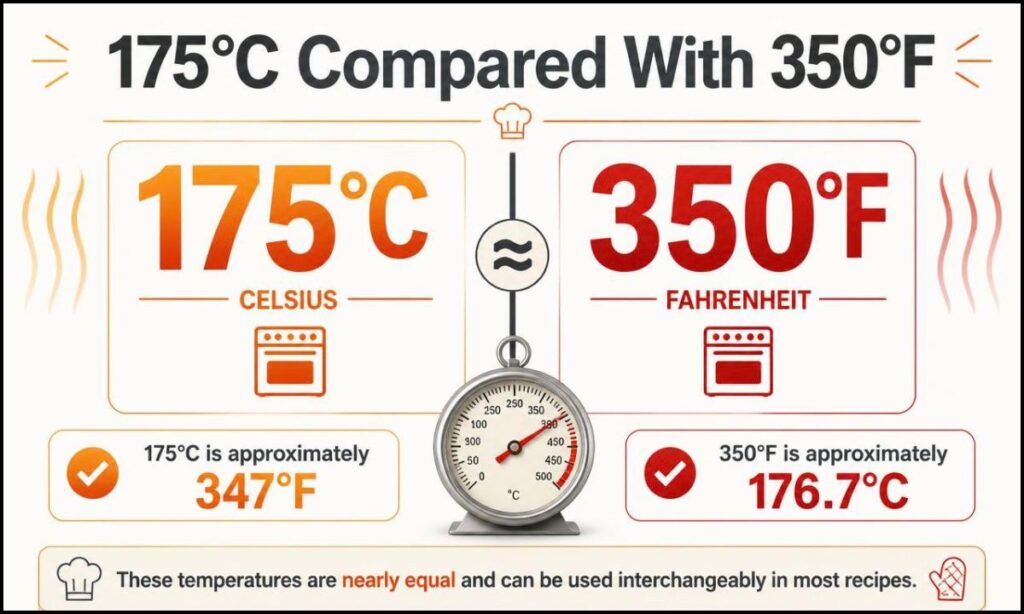
Technically, 175°C = 347°F, not 350°F.
But in normal recipe writing, 350°F is commonly used as a rounded equivalent. The 3°F difference is generally insignificant for ordinary home cooking, especially because household ovens aren’t perfectly precise instruments.
If you are doing highly controlled scientific work, industrial production, material testing, or a process involving strict technical specifications, you would not casually round the number. In those settings, temperature measurement can be critical.
A kitchen is a different environment.
For a cake, muffins, cookies, or banana bread, setting an oven to 350°F when a recipe specifies 175°C is usually a perfectly sensible practical choice.
Why Temperature Conversion Matters in International Recipes
Modern cooking has become wonderfully international. A recipe can begin in Paris, be adapted in London, posted by someone in Toronto, cooked in Lahore, and somehow end up being shared with a baker in Texas.
The recipe doesn’t know which country your oven lives in.
That’s why Celsius Fahrenheit conversion is so useful.
Many European recipes use Celsius, while American recipes commonly use Fahrenheit. Australia and New Zealand also frequently use Celsius. A person cooking in Pakistan may encounter either system depending on the source of the recipe.
This makes recipe temperature conversion an everyday example of how different measurement standards meet in ordinary life.
The same idea appears outside cooking. Engineers, scientists, manufacturers, and researchers may need metric to imperial conversion when working with international teams or older technical specifications.
In international manufacturing, for example, temperature can matter during plastic processing, metal treatment, electronics production, product quality control, and material testing. A misunderstanding in a technical temperature specification isn’t as harmless as choosing 347°F instead of 350°F for a cake.
Celsius, Fahrenheit, and the Bigger World of Measurement
Temperature conversion is part of a much larger story about how humans measure things.
The Metric System is dominant across most of the world and connects closely with the SI units used in scientific measurement. The Customary System and related Imperial System measurements remain important in particular countries and industries.
Scientists working in science laboratories, engineers involved in engineering projects, and researchers conducting climate studies or medical research need consistent measurement systems so results can be compared across borders.
The kitchen has a much more relaxed version of the same problem.
One cook says 175°C. Another says 347°F. Both are talking about the same oven heat.
That small conversion becomes a miniature lesson in global collaboration, really.
A Quick Mental Guide for Celsius to Fahrenheit
You don’t always need a calculator.
For common cooking temperatures, having a small Celsius to Fahrenheit chart nearby can save time.
Some useful reference points are:
- 0°C = 32°F — freezing point of water
- 20°C = 68°F — comfortable room temperature
- 30°C = 86°F — warm conditions
- 160°C = 320°F — common baking range
- 170°C = 338°F
- 175°C = 347°F
- 180°C = 356°F
- 190°C = 374°F
- 200°C = 392°F
- 100°C = 212°F — boiling point of water
For everyday recipes, you don’t need to memorize the entire chart. Knowing a few common points is usually enough to estimate where a recipe belongs.
175°C to F for Baking: A Practical Example
Imagine you’ve found a European recipe for a vanilla cake.
The instructions say:
“Preheat the oven to 175°C and bake for 30–35 minutes.”
If your oven uses Fahrenheit, you now know that 175°C in Fahrenheit is 347°F.
If your oven allows precise temperature entry, choose 347°F.
If it only has standard settings, choose approximately 350°F.
Then preheat the oven fully before putting the cake inside. This part gets forgotten surprisingly often, and the poor cake pays the price.
You can begin checking the cake near the lower end of the suggested baking time, but don’t open the oven repeatedly. Every opening allows heat to escape, and delicate baked goods can respond badly to temperature changes.
Use the recipe’s visual and physical cues as well. A cake that is golden, set in the center, and passes a suitable skewer test is giving you more information than the clock alone.
Is 175°C Good for Every Recipe?

No, and this is worth saying clearly.
175°C is not a universal baking temperature.
Some recipes need a lower oven setting, while others need considerably more heat. Bread, pastry, pizza, roasted meat, cookies, cakes, and vegetables can all behave differently.
Even two cakes may require different temperatures because of their size, ingredients, pan shape, and desired texture.
So while 175°C baking temperature is useful for many recipes, don’t automatically replace every recipe’s temperature with 175°C just because you know the conversion.
The recipe is the starting point. The conversion simply lets your oven speak the same language.
When a Temperature Converter Is Useful
A temperature converter is especially handy when you are working with unfamiliar international recipes or technical information.
A temperature calculator online can perform the calculation instantly, but knowing the formula is still useful because you can check whether the result makes sense.
For instance, if someone tells you that 175°C equals 700°F, your mathematical instincts should immediately say, “Well, that seems a bit wild.”
The standard formula gives the reliable result: 347°F.
For ordinary cooking, you can use a chart, calculator, or manual conversion. For scientific and engineering work, however, always follow the relevant measurement standards and required precision.
How to Remember 175°C to F
If you regularly cook from international recipes, you can simply remember this pairing:
175°C = 347°F ≈ 350°F
The first number is the exact conversion, while the second is the convenient oven setting many people use.
Think of it as three ways of saying almost the same kitchen instruction: 175 Celsius, 347 Fahrenheit, or roughly 350 Fahrenheit.
Once you’ve seen it enough times, it starts sticking in your head without any effort. And honestly, that’s probably the best kind of kitchen math.
Read more : What Time Was It 5 Hours Ago?
Frequently Asked Questions
What is 175 degrees Celsius in Fahrenheit?
175 degrees Celsius is 347 degrees Fahrenheit. The exact conversion is 175°C = 347°F using the standard Celsius to Fahrenheit formula.
What is 175 Celsius equal to in Fahrenheit for an oven?
For an oven, 175°C equals 347°F. If your oven does not offer 347°F, setting it to 350°F is the common rounded practical equivalent.
Is 175°C a moderate oven temperature?
Yes. 175°C / 347°F is generally considered a moderate oven temperature and is commonly suitable for cakes, muffins, quick breads, cookies, and various baked dishes.
Is 175°C good for baking?
Yes, 175°C is good for baking many cakes and other baked goods, although the ideal temperature always depends on the specific recipe and desired result.
What is the Fahrenheit equivalent of 175?
The Fahrenheit equivalent of 175°C is 347°F. Using the formula F = (C × 9/5) + 32 gives the exact result.
How do you convert 175 Celsius to Fahrenheit?
Multiply 175 by 9/5 and then add 32:
(175 × 9/5) + 32 = 347°F
What is 175°C in Fahrenheit for baking?
For baking, 175°C is 347°F, usually rounded to 350°F when using a standard Fahrenheit oven setting.
Is 350°F the same as 175°C?
Not exactly. 350°F is approximately 176.7°C, while 175°C is exactly 347°F. In everyday baking, however, the difference is usually small enough that recipes often treat them as practical equivalents.
Conclusion
So, if a recipe asks for 175°C, you now know exactly what to do.
The precise Celsius to Fahrenheit conversion is:
175°C = 347°F
For everyday baking, you can generally use 350°F when your oven doesn’t have a 347°F setting. This temperature is commonly suitable for cakes, muffins, cookies, quick breads, brownies, and many other recipes that call for moderate heat.
More importantly, understanding the conversion helps you move comfortably between international recipes. Whether you’re cooking a European recipe in Pakistan, following an American baking guide in France, or experimenting with a recipe shared from Australia or New Zealand, the food doesn’t care which temperature scale you prefer. It only responds to the actual heat.
And that’s the funny little beauty of temperature conversion: two completely different-looking numbers can describe exactly the same physical reality.
So next time you see 175 degrees Celsius staring back at you from a recipe, don’t pause too long. Set your oven to 347°F, or approximately 350°F, and get on with the good part — the baking.
