


When someone asks 1 knot in miles per hour, the answer is surprisingly simple: 1 knot = 1.15078 mph. A knot is a traditional speed unit used heavily in aviation and maritime travel, while miles per hour (MPH) is more familiar in everyday road-speed conversations.
At first, the two units can feel like they’re speaking different languages. One belongs to ships, aircraft, and nautical charts; the other feels more like highways and speedometers. But once you know the conversion factor, moving between knots and mph becomes almost effortless.
So, if you’re wondering what is 1 knot in mph, how to calculate it manually, or how values such as 25 or 100 knots translate into miles per hour, this guide walks through the whole thing without making the math feel like a school punishment.
What Is 1 Knot in Miles per Hour?
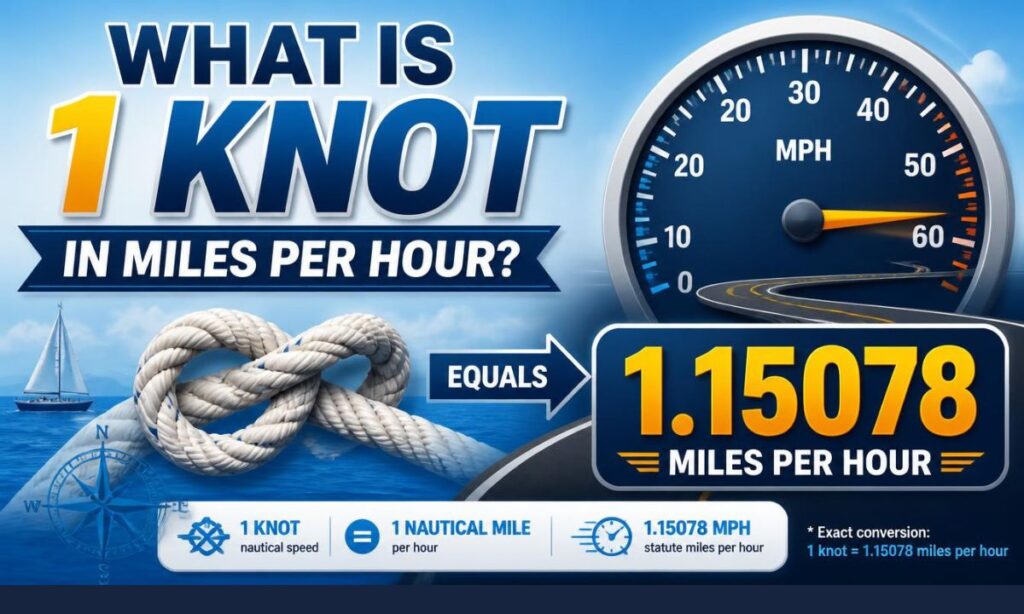
The exact answer is 1 knot = 1.15078 mph. For a quick calculation, you can round this to 1 knot ≈ 1.15 mph, which is usually accurate enough for everyday estimates.
A knot is a unit of speed equal to one nautical mile per hour. In other words, if a vessel travels at 1 knot, it covers one nautical mile in one hour.
Because 1 nautical mile = 1.15078 miles, the relationship between the two speed units follows naturally. Nothing mysterious is happening behind the curtain, just a different definition of distance.
For most practical speed conversion work, you can remember the tiny phrase: one knot, about one point one five miles per hour.
How Many MPH Is 1 Knot?
The answer is 1.15078 miles per hour. If your calculation doesn’t need five decimal places, saying 1 knot ≈ 1.15 mph is perfectly reasonable.
This is useful when reading marine weather reports, aircraft information, wind speeds, or nautical navigation data. A speed given in knots can look unfamiliar until you translate it into the road-speed unit you’re used to.
For example, a wind speed of 1 knot means the air is moving at about 1.15 MPH. It’s a very gentle speed, and probably not something anyone would dramatically announce unless they were making a weather chart.
The Knot and the Nautical Mile
The knot has a direct connection to the nautical mile. One knot means one nautical mile traveled in one hour.
A nautical mile is slightly longer than a standard mile:
- 1 nautical mile = 1.15078 miles
- 1 knot = 1 nautical mile per hour
- Therefore, 1 knot = 1.15078 miles per hour
The nautical mile is associated with navigation and the geometry of Earth’s latitude, which is one reason it fits naturally into marine and aviation measurement.
This distinction matters because confusing a nautical mile with a regular mile can make a conversion look wrong when the arithmetic is actually fine.
How to Convert Knots to MPH
The easiest knots to mph conversion uses a simple multiplication:
Miles per hour = knots × 1.15078
So, to convert knots to mph, take the number of knots and multiply it by the conversion factor 1.15078.
For example, if a boat is moving at 10 knots:
10 × 1.15078 = 11.5078 mph
Rounded to two decimal places, that’s 11.51 mph.
You don’t need an elaborate conversion calculator for this. A basic phone calculator, a piece of paper, or even some mental arithmetic can handle it, though the calculator is obviously less likely to wander off into mathematical nonsense.
The Knots to MPH Conversion Formula
The standard knots to mph formula is:
MPH = Knots × 1.15078
The reverse conversion, or MPH to knots, works like this:
Knots = MPH ÷ 1.15078
These two equations let you move between knots and mph in either direction.
If you’re working with a value that doesn’t require high accuracy, multiplying by 1.15 is enough for a fast estimate. For technical work, however, retaining more decimal places gives you a more precise result.
Why Is the Conversion Factor 1.15078?
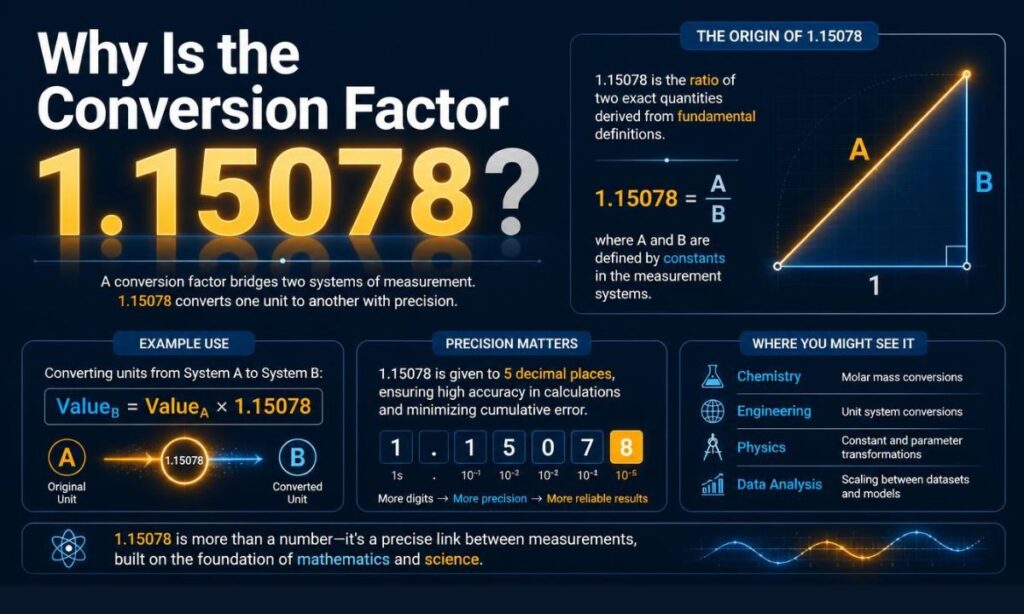
The conversion factor comes from the relationship between a nautical mile and a standard mile.
Since:
1 nautical mile = 1.15078 miles
and:
1 knot = 1 nautical mile per hour
it follows that:
1 knot = 1.15078 miles per hour
That’s the entire foundation of the conversion. The speed unit itself isn’t being arbitrarily adjusted; you’re simply expressing the same rate using another distance unit.
This is a useful example of unit conversion, where one measurement is rewritten in another system while representing the same physical quantity.
Quick 1 Knot to MPH Calculation
If you only need the answer quickly, remember these two versions:
- Exact conversion: 1 knot = 1.15078 mph
- Rounded conversion: 1 knot ≈ 1.15 mph
For a nearest whole number result, 1 knot rounds to 1 mph.
That last version is convenient but not especially precise. Rounding is useful when communicating approximate speeds, while decimal values are better when the difference actually matters.
Knots to MPH Worked Examples
Let’s make the conversion a little more practical. These worked examples show how the same method handles several different speeds.
10 Knots to MPH
Multiply 10 by 1.15078:
10 × 1.15078 = 11.5078 mph
So, 10 knots = 11.51 mph.
15 Knots to MPH
15 × 1.15078 = 17.2617 mph
Therefore, 15 knots = 17.26 mph.
20 Knots to MPH
20 × 1.15078 = 23.0156 mph
So, 20 knots = 23.02 mph.
25 Knots to MPH
25 × 1.15078 = 28.7695 mph
Therefore, 25 knots = 28.77 mph.
30 Knots to MPH
30 × 1.15078 = 34.5234 mph
So, 30 knots = 34.52 mph.
40 Knots to MPH
40 × 1.15078 = 46.0312 mph
That gives 40 knots = 46.03 mph.
More Knots to MPH Examples
For larger values, the exact same multiplication keeps working. The number gets bigger, but the conversion doesn’t suddenly develop a personality of its own.
| Knots | Miles per hour |
|---|---|
| 1 | 1.15 mph |
| 10 | 11.51 mph |
| 15 | 17.26 mph |
| 20 | 23.02 mph |
| 25 | 28.77 mph |
| 30 | 34.52 mph |
| 40 | 46.03 mph |
| 50 | 57.54 mph |
| 60 | 69.05 mph |
| 80 | 92.06 mph |
| 100 | 115.08 mph |
| 120 | 138.09 mph |
| 140 | 161.11 mph |
| 160 | 184.12 mph |
| 180 | 207.14 mph |
| 200 | 230.16 mph |
| 1000 | 1,150.78 mph |
This conversion table is handy when you need a quick answer without performing the multiplication each time.
12 Knots to MPH
For a commonly searched example, 12 knots can be converted as follows:
12 × 1.15078 = 13.80936 mph
Rounded to two decimal places:
12 knots = 13.81 mph
If you’re only interested in the nearest whole mile per hour, that’s about 14 mph.
42 Knots to MPH
For 42 knots:
42 × 1.15078 = 48.33276 mph
So:
42 knots = 48.33 mph
The result shows why keeping decimal places can be useful. Simply multiplying by 1.15 gives nearly the same answer, but the extra digits preserve a little more conversion accuracy.
100 Knots to MPH
At 100 knots, the calculation becomes especially easy:
100 × 1.15078 = 115.078 mph
Therefore:
100 knots = 115.08 mph
A speed of 100 knots is considerably faster than 100 mph because each knot represents more than one standard mile per hour.
Why Knots Are Used for Ships and Aircraft
You may wonder why people don’t simply use miles per hour everywhere. The reason is partly historical and partly practical.
Knots are deeply established in maritime and aviation navigation. Nautical charts, marine forecasts, aircraft information, and many navigation systems commonly use knots because the unit connects naturally with nautical miles.
The relationship with geographical coordinates also makes nautical measurements useful for navigation. A nautical mile is based on Earth’s geometry, making it particularly convenient when working with latitude and longitude.
So, when someone reports a vessel traveling at 20 knots, they’re using a nautical speed measurement, not choosing a strange unit just to make everyone’s afternoon harder.
Knots Versus Miles per Hour
The biggest difference between knots and mph is the distance unit behind each measurement.
A mile per hour describes how many standard miles are covered in one hour. A knot describes how many nautical miles are covered in one hour.
That means:
- 1 knot = 1.15078 mph
- 1 mph ≈ 0.868976 knots
- Knots are common in maritime and aviation contexts.
- MPH is common in road transportation in countries that use miles.
Neither unit changes the actual physical speed. They simply describe it using different measurement units.
MPH to Knots: The Reverse Conversion
Sometimes the question goes in the opposite direction. Instead of asking how to convert knots to mph, you may need to convert miles per hour to knots.
Use:
Knots = MPH ÷ 1.15078
For example, suppose a speed is 50 mph:
50 ÷ 1.15078 ≈ 43.45 knots
So, 50 miles per hour is approximately 43.45 knots.
Remembering both directions makes speed unit conversion much easier, especially if you’re switching between marine information and everyday speed measurements.
Using a Knots to MPH Converter
A knots to mph converter can save time when you’re working with many values. You enter the speed in knots, select the desired unit, and the online calculator handles the arithmetic.
A useful speed calculator can also reduce mistakes when you’re working with several decimal places. This matters when the result is being used for navigation, technical calculations, data analysis, or another situation where approximation isn’t quite good enough.
For casual questions, though, the simple conversion factor is usually all you need. Sometimes the best calculator is the one already sitting between your ears, even if it takes a second longer.
Accuracy and Decimal Places
How many decimal places should you use? That depends on why you’re doing the conversion.
For a casual conversation, 1 knot ≈ 1.15 mph is more than sufficient. If you need a quick estimate, you can even use 1.15 as the 1.15 mph per knot approximation.
For more precise calculations, use 1.15078. Keeping five decimal places gives you a closer mathematical conversion.
When presenting the final result, two decimal places are often a sensible compromise:
1 knot = 1.15 mph
The important thing is to avoid pretending that a rounded answer is more precise than it really is.
Quick Knots to MPH Conversion Facts
Here are a few facts worth keeping nearby:
- 1 knot = 1.15078 mph
- 1 knot ≈ 1.15 mph
- 1 knot = 1 nautical mile per hour
- 1 nautical mile = 1.15078 miles
- To convert knots to mph, multiply by 1.15078.
- To convert mph to knots, divide by 1.15078.
- For a rough calculation, multiply knots by 1.15.
- For whole-number results, round the final answer rather than the conversion factor too early.
These small facts turn a seemingly unfamiliar measurement into something you can work with almost instantly.
Knots to MPH Worksheet and Practice
Students and learners can practice knots to mph using a conversion worksheet. Start with simple values such as 1, 5, 10, and 20 knots, then gradually introduce decimal values.
A printable worksheet can include questions such as:
- Convert 5 knots to mph.
- Convert 12 knots to mph.
- Convert 25 knots to mph.
- Convert 42 knots to mph.
- Convert 100 knots to mph.
- Convert 50 mph to knots.
The point isn’t merely memorizing the answers. Practice helps you understand the conversion formula, identify which unit you start with, and choose the correct operation.
An answer sheet can then be used to check the calculations after the learner has worked through the problems independently.
Common Mistakes When Converting Knots to MPH
One common mistake is assuming that a knot is exactly equal to one mile per hour. It isn’t. A knot is based on a nautical mile, which is longer than a standard mile.
Another mistake is using multiplication when the conversion actually requires division. If you’re going from knots to mph, multiply by 1.15078. If you’re going from mph to knots, divide by 1.15078.
Rounding too early is another small troublemaker. If several calculations depend on the result, keep more decimal places during the working and round only at the end.
How to Remember 1 Knot in Miles per Hour
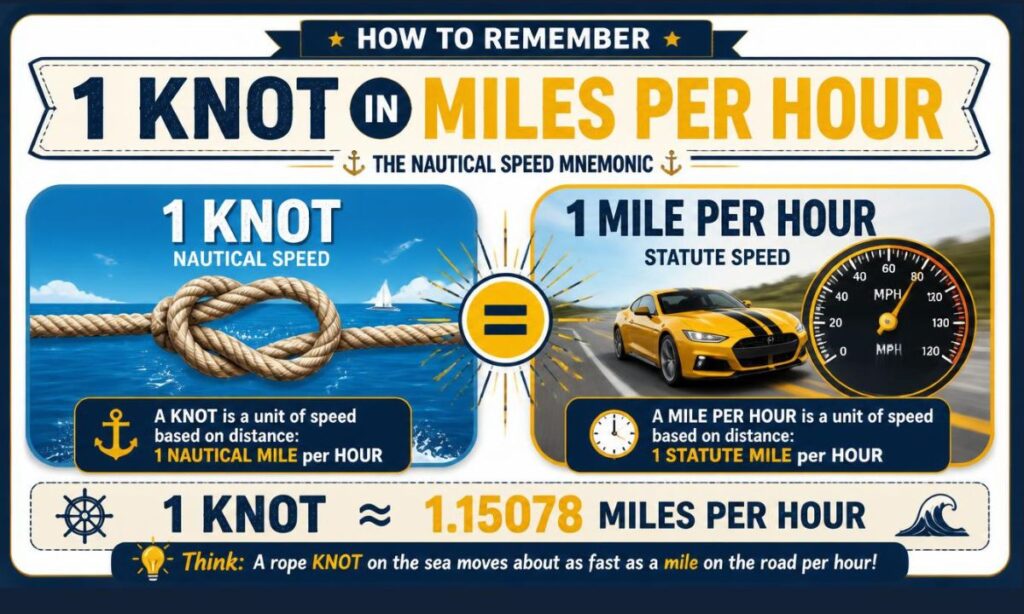
If memorizing numbers isn’t your favorite hobby, use the short version:
1 knot ≈ 1.15 mph
That is usually enough for quick mental calculations.
For example, 20 knots becomes roughly:
20 × 1.15 = 23 mph
And 50 knots becomes:
50 × 1.15 = 57.5 mph
It’s not the full precision of 1.15078, but for a fast estimate, it works nicely.
Frequently Asked Questions
How Many Miles per Hour Is 1 Knot?
1 knot is equal to 1.15078 miles per hour (mph). For quick calculations, you can round it to about 1.15 mph.
How Do You Convert 1 Knot to MPH?
To convert knots to miles per hour, multiply the number of knots by 1.15078. For 1 knot, the calculation is 1 × 1.15078 = 1.15078 mph.
What Is the Difference Between a Knot and MPH?
A knot measures one nautical mile per hour, while MPH measures standard miles per hour. One knot is slightly faster than one mile per hour.
Is 1 Knot the Same as 1 MPH?
No, 1 knot is not exactly equal to 1 MPH. 1 knot ≈ 1.15 MPH, so a knot represents a slightly higher speed.
Conclusion
The answer to 1 knot in miles per hour is straightforward: 1 knot = 1.15078 mph, or approximately 1.15 mph when rounded.
Once you understand that a knot represents one nautical mile per hour, the whole conversion makes much more sense. You aren’t learning a random number; you’re translating between a nautical measurement and a standard mile-based speed.
Whether you’re checking a marine forecast, studying navigation, reading aviation information, solving a classroom problem, or simply wondering how many mph is 1 knot, the same conversion works every time.
Keep the key relationship close: 1 knot = 1.15078 mph. From there, converting knots to miles per hour is just a small multiplication, and suddenly a unit that once looked rather nautical becomes plain old everyday math.
