


At first glance, 1 1/4 inches looks like a tiny measurement that should not need much explaining. Yet this little fraction appears everywhere: on a ruler, beside a screw size, in a workshop notebook, on a pipe fitting, or inside a technical drawing.
Sometimes a person simply wants to know what 1 1/4 in inches means in decimal form, while someone else needs the exact metric equivalent in millimeters or centimeters. The answer is actually quite simple, but getting the details right matters.
The measurement 1 1/4 inch is equal to 1.25 inches. In metric units, it is exactly 31.75 millimeters or 3.175 centimeters. Thats the basic answer, but understanding why these numbers work makes other fractional measurements much easier to handle too.
This guide explains the fractional inch, decimal inch, and metric equivalents of this measurement. It also shows how an inch converter, conversion calculator, or simple formula can be used when you need to convert similar values.
What Does 1 1/4 Inches Mean?
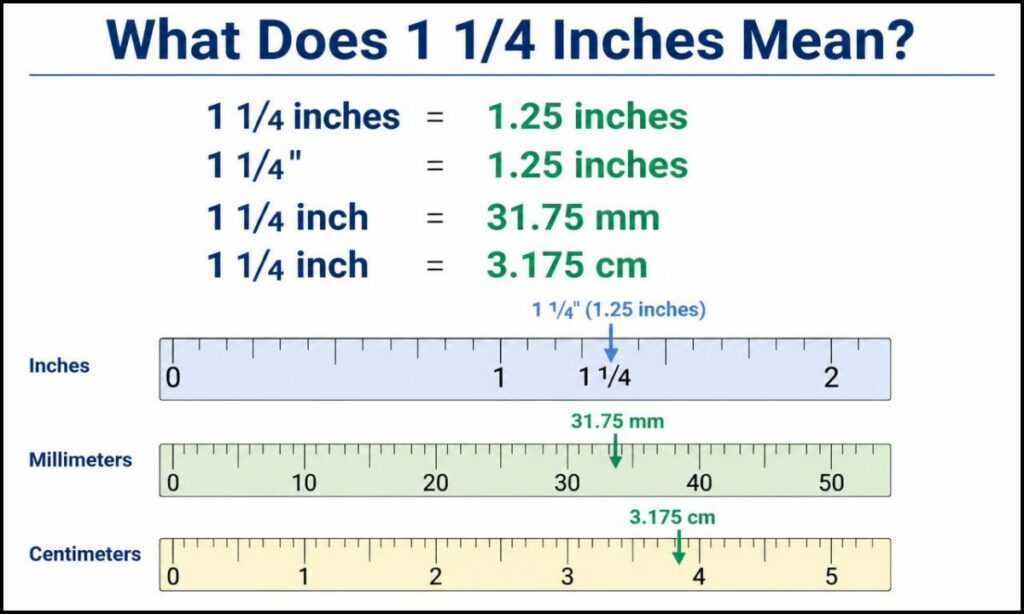
The expression 1 1/4 inches contains two parts: a whole 1 inch and a fractional 1/4 inch. When these two parts are combined, the total is one and one-quarter inches. In decimal notation, that becomes 1.25 inches.
So:
- 1 1/4 inches = 1.25 inches
- 1 1/4″ = 1.25 inches
- 1 1/4 inch = 31.75 mm
- 1 1/4 inch = 3.175 cm
The quotation mark, “, is commonly used as the inch symbol. Therefore, when you see 1 1/4″, it normally means exactly the same measurement as 1 1/4 inches.
The fraction is especially common in the traditional inch system and imperial measurement. It is still widely encountered in technical work, construction, woodworking, plumbing, manufacturing, and other areas where inch-sized dimensions remain useful.
1 1/4 Inches in Decimal Form
To convert 1 1/4 inches into a decimal inch, convert the fraction first. The fraction 1/4 means one divided by four:
1 ÷ 4 = 0.25
Then add the whole inch:
1 + 0.25 = 1.25 inches
Therefore, the 1 1/4 inches in decimal value is 1.25 inches.
This is also called the 1 1/4 inch decimal equivalent. It can be useful when entering measurements into software, spreadsheets, calculators, CNC equipment, or digital measuring systems where decimal values are easier to process than fractions.
A quick way to remember it is that every quarter of an inch represents 0.25 inch. So 1/4 inch = 0.25, 2/4 inch = 0.50, 3/4 inch = 0.75, and 4/4 inch = 1 inch. Pretty straightforward once you see the pattern.
1 1/4 Inch to Millimeters
If you need 1 1/4 inch to mm, the exact answer is:
1 1/4 inches = 31.75 millimeters
The standard relationship is:
1 inch = 25.4 millimeters
Since the decimal value of 1 1/4 inches is 1.25, multiply:
1.25 × 25.4 = 31.75 mm
Therefore:
1 1/4″ = 31.75 mm
This is the answer you would normally use for 1 1/4″ to millimeters, 1.25 inches to mm, or when someone asks, “how many mm is 1 1/4 inches?”
The result is exact, not a rounded estimate. That distinction can be important in precision measurement, particularly when working with parts that must fit together correctly.
1 1/4 Inch to Centimeters
The centimeter conversion is just as simple. Since 1 inch equals 2.54 centimeters, multiply the decimal measurement by 2.54.
1.25 × 2.54 = 3.175 cm
Therefore:
1 1/4 inches = 3.175 centimeters
So if someone searches for 1 1/4 inch to cm, 1 1/4″ to centimeters, or asks “how many cm is 1 1/4 inches?”, the answer is 3.175 cm.
For everyday work, you might see this rounded to 3.18 cm. However, 3.175 cm is the exact mathematical conversion based on the international inch definition.
Quick 1 1/4 Inches Conversion Table
Here is a compact conversion table for the measurement:
| Measurement | Equivalent |
|---|---|
| Fractional value | 1 1/4 inches |
| Decimal value | 1.25 inches |
| Millimeters | 31.75 mm |
| Centimeters | 3.175 cm |
| Inch symbol | 1 1/4″ |
| Metric equivalent | 31.75 mm / 3.175 cm |
This small inch conversion table is handy when you only need the answer and dont want to work through the formula every time.
Why 1 Inch Equals 25.4 Millimeters
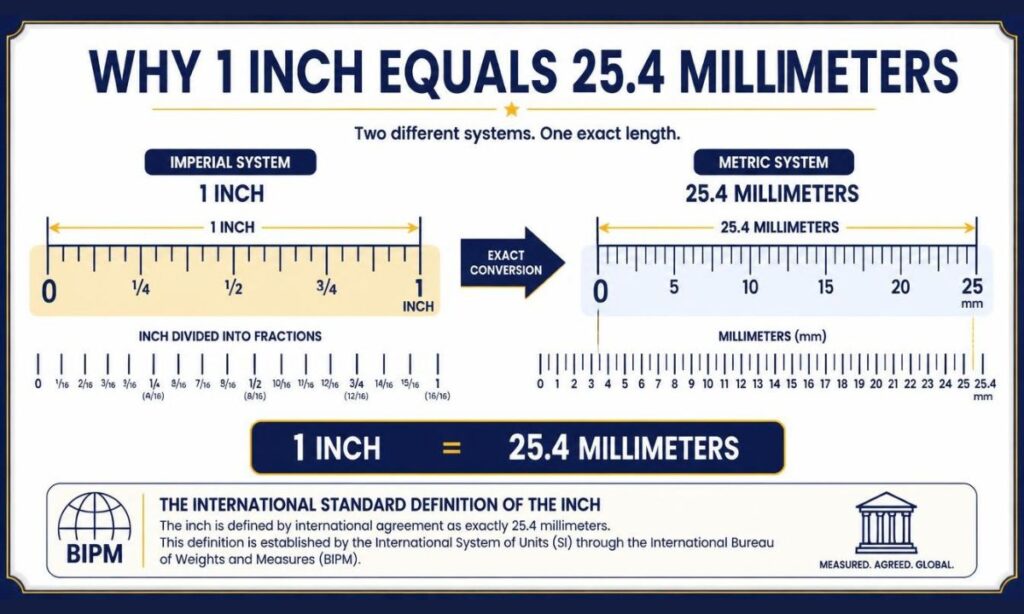
The foundation of almost every inch to metric conversion is the relationship between one inch and millimeters.
One inch is defined as exactly:
1 inch = 25.4 millimeters
Since a centimeter contains 10 millimeters:
25.4 mm = 2.54 cm
So we also have:
1 inch = 2.54 centimeters
These values make fractional measurement conversion quite easy. You simply turn the fraction into a decimal and multiply by 25.4 for millimeters or 2.54 for centimeters.
For 1 1/4 inches, that means:
1.25 × 25.4 = 31.75 mm
and:
1.25 × 2.54 = 3.175 cm
No complicated machinery is needed, although an online calculator can certainly save a few seconds.
Understanding the Fractional Inch
A fractional inch divides one inch into smaller portions. Common fractions include 1/64 inch, 1/32 inch, 1/16 inch, 3/32 inch, 1/8 inch, 5/32 inch, 3/16 inch, 7/32 inch, and larger values.
Some frequently encountered measurements are:
- 1/4 inch
- 5/16 inch
- 3/8 inch
- 7/16 inch
- 1/2 inch
- 9/16 inch
- 5/8 inch
- 11/16 inch
- 3/4 inch
- 13/16 inch
- 7/8 inch
- 15/16 inch
- 31/32 inch
The fraction 1 1/4 inches simply extends this idea beyond a single inch. It means one complete inch plus another quarter inch.
A fractional inch chart is often useful when working with rulers, drill bits, sockets, fasteners, and other precision tools. Once the common fractions become familiar, reading an inch-based ruler becomes much less mysterious.
1 1/4 Inches and the Inch Measurement System
The inch is part of the traditional imperial measurement and is also used within the broader Anglo-American measurement system. Although the metric system dominates many scientific and international applications, inches remain common in several Anglo-American regions.
For this reason, both fractional and decimal inch measurements continue to appear in engineering drawings, product specifications, hardware sizes, woodworking plans, and technical instructions.
Someone may describe a part as 1 1/4 inches, while a manufacturer elsewhere may specify its metric equivalent as 31.75 mm. The physical dimension is the same; only the unit system has changed.
This is why understanding inch conversion is more than just a calculator trick. It allows measurements from different systems to communicate with each other without confusion.
Using 1 1/4 Inches in Real-World Measurements
The measurement 1 1/4 inches can appear in many practical situations. A woodworker may need a board opening with this dimension. A mechanic could encounter a component described using an inch-sized specification. A plumber might see a nominal pipe size involving 1 1/4 inches, although pipe sizing itself can have conventions that mean the stated nominal size should not automatically be treated as a measured outside diameter.
In precision mechanics, exact dimensions can matter considerably. A difference of even a fraction of a millimeter may affect whether two components fit together properly.
The same applies to model making, where tiny differences can become visually obvious. In such work, a conversion from fractional inches to mm should be performed carefully rather than estimated by eye.
1 1/4 Inches for Tools, Screws and Threads
In workshops, measurements in inches are often connected with tools, screws, threads, and other hardware. An inch-based socket, wrench, or drill specification may use fractional sizing rather than metric sizing.
For example, an inch-sized tool might be marked with a fractional measurement while another tool uses millimeters. If you know that 1 1/4 inches equals 31.75 mm, you have a useful reference point when comparing the two systems.
However, conversion should not be confused with interchangeability. A metric tool measuring close to 31.75 mm is not automatically the correct replacement for a 1 1/4-inch tool. Thread standards, tolerances, profiles, and manufacturing specifications can be different. Thats one of those little workshop details that saves trouble later.
1 1/4 Inches in Precision Measurement
In engineering measurements and technical fields, precision can be more important than simply knowing an approximate number.
For example, saying that 1 1/4 inches is “about 32 mm” may be acceptable for a rough estimate. But if a component is being machined, 31.75 mm may be the value that actually matters.
The difference between 31.75 mm and 32 mm is only 0.25 mm, but small differences can matter in precision mechanics. This is where precision measurement tools, digital calipers, micrometers, and carefully prepared drawings become useful.
When accuracy is important, use the exact conversion rather than rounding too early.
Fractional Inches to Decimal Inches
Converting fractions into decimals is one of the easiest ways to understand the inch system.
For 1 1/4 inches:
1 + (1 ÷ 4) = 1.25 inches
The same method works with many other common fractional inches:
| Fraction | Decimal |
|---|---|
| 1/64 inch | 0.015625 |
| 1/32 inch | 0.03125 |
| 1/16 inch | 0.0625 |
| 3/32 inch | 0.09375 |
| 1/8 inch | 0.125 |
| 5/32 inch | 0.15625 |
| 3/16 inch | 0.1875 |
| 7/32 inch | 0.21875 |
| 1/4 inch | 0.25 |
| 5/16 inch | 0.3125 |
| 3/8 inch | 0.375 |
| 7/16 inch | 0.4375 |
| 1/2 inch | 0.5 |
| 9/16 inch | 0.5625 |
| 5/8 inch | 0.625 |
| 11/16 inch | 0.6875 |
| 3/4 inch | 0.75 |
| 13/16 inch | 0.8125 |
| 7/8 inch | 0.875 |
| 15/16 inch | 0.9375 |
Once you understand this inch fraction conversion, larger mixed numbers such as 1 1/4 inches become much easier to handle.
Converting 1 1/4 Inches with an Online Converter
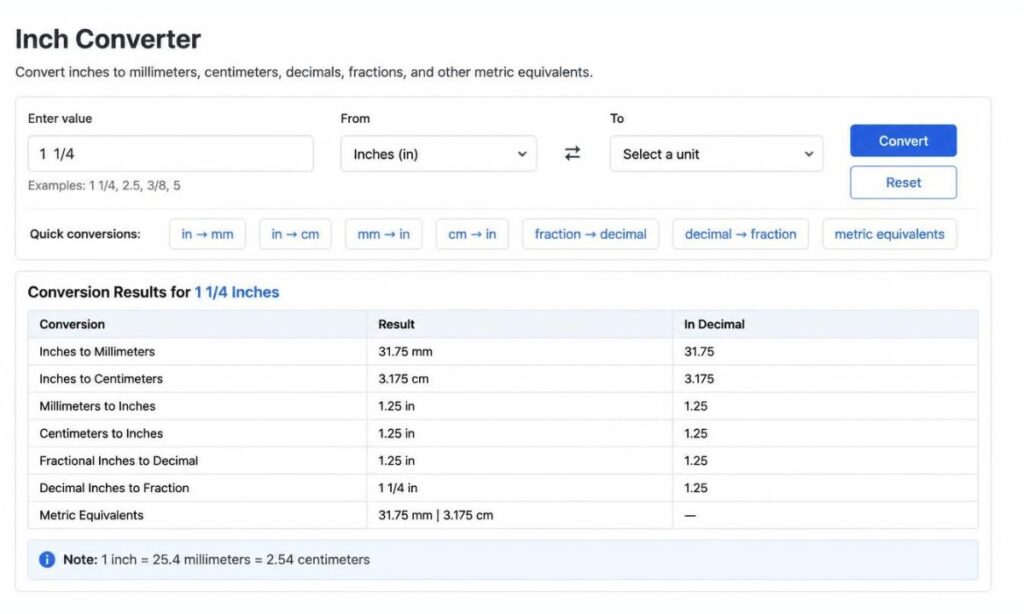
An online converter can be useful when you need to convert many measurements quickly. Instead of manually multiplying every value, you can enter 1.25 inches and select millimeters or centimeters.
A typical inch converter may provide:
- inches to millimeters
- inches to centimeters
- millimeters to inches
- centimeters to inches
- fractional inches to decimals
- decimal inches to fractions
- metric equivalents
A good conversion calculator should clearly show whether its result is exact or rounded. This matters especially when the number will be used for technical work.
For one simple conversion, however, remembering 25.4 mm per inch and 2.54 cm per inch is often quicker than opening a calculator.
1 1/4 Inches Compared with Nearby Fractional Measurements
Sometimes the easiest way to understand a measurement is by placing it beside nearby values.
1 1/4 inches is larger than 1 inch and smaller than 1 1/2 inches. In decimal form:
- 1 inch = 1.00 inches
- 1 1/4 inches = 1.25 inches
- 1 1/2 inches = 1.50 inches
- 1 3/4 inches = 1.75 inches
- 2 inches = 2.00 inches
This makes the measurement easy to visualize on an ordinary ruler. The quarter-inch portion represents one of four equal divisions of an inch.
If a ruler is marked in sixteenths, 1 1/4 inches can also be written as 1 4/16 inches, because 1/4 equals 4/16. That gives another way to locate it accurately.
A Simple Formula for 1 1/4 Inch Conversion
If you want to calculate the conversion yourself, keep these two formulas nearby.
For millimeters:
Inches × 25.4 = millimeters
For centimeters:
Inches × 2.54 = centimeters
Using 1.25 inches:
1.25 × 25.4 = 31.75 mm
1.25 × 2.54 = 3.175 cm
For the reverse direction, the formulas are:
Millimeters ÷ 25.4 = inches
Centimeters ÷ 2.54 = inches
This is the basic foundation behind an inches to millimeters converter, inches to centimeters converter, mm to inches converter, and cm to inches converter.
Why Exact Conversion Matters
There are times when rounding is perfectly reasonable. If you are estimating the size of an object for a general description, saying 1 1/4 inches is roughly 32 mm may be enough.
But in technical work, the exact value is preferable. 31.75 mm contains information that the rounded value 32 mm does not.
This matters for precision tools, engineering drawings, manufactured components, and measurements involving screws, threads, and materials. A small rounding error can sometimes become a bigger fitting problem when several dimensions are combined.
So the practical rule is simple: use the exact value when accuracy matters, and use a rounded metric equivalent only when the application allows it.
1 1/4 Inches: Final Conversion Summary
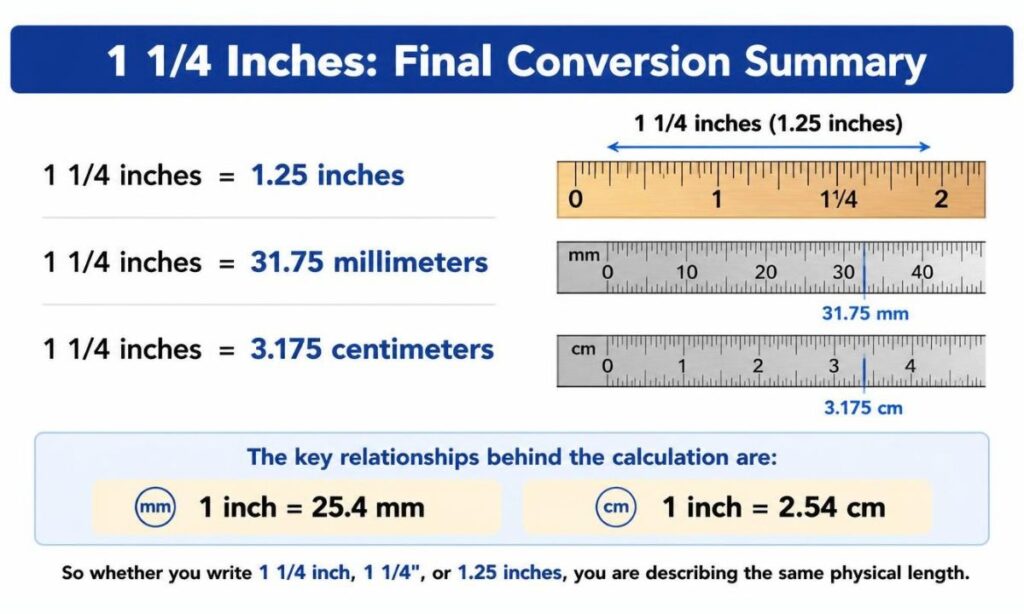
The measurement can now be summarized very simply:
1 1/4 inches = 1.25 inches
1 1/4 inches = 31.75 millimeters
1 1/4 inches = 3.175 centimeters
The key relationships behind the calculation are:
1 inch = 25.4 mm
1 inch = 2.54 cm
So whether you write 1 1/4 inch, 1 1/4″, or 1.25 inches, you are describing the same physical length.
Understanding this also makes other measurements easier. Once the relationship between a fractional inch, decimal inch, and metric units becomes familiar, conversions such as 1 1/2 inches, 2 3/8 inches, or 3 7/16 inches stop looking like strange little puzzles.
Frequently Asked Questions
What is 1 1/4 inches in decimal?
It is 1.25 inches.
How many mm is 1 1/4 inches?
It is exactly 31.75 mm.
How many cm is 1 1/4 inches?
It is exactly 3.175 cm.
What is 1.25 inches in mm?
1.25 inches = 31.75 mm.
What is 1.25 inches in cm?
1.25 inches = 3.175 cm.
What is 1 1/4″ in millimeters?
It is 31.75 millimeters.
What is the metric equivalent of 1 1/4 inches?
The metric equivalent is 31.75 mm, or 3.175 cm.
Conclusion
A measurement like 1 1/4 inches may look ordinary, but it sits at an interesting meeting point between fractional measurement and modern metric conversion. In the traditional inch system, it is written as a mixed fraction. In decimal notation, it becomes 1.25 inches. In the metric system, it becomes 31.75 mm or 3.175 cm.
That makes the answer useful in everything from everyday measuring to model making, workshop projects, precision mechanics, and technical applications. You dont really need to memorize dozens of conversions either; remembering 25.4 millimeters per inch and 2.54 centimeters per inch gives you the foundation for nearly all of them.
So whenever you come across 1 1/4 inches, remember the three forms: 1 1/4 inch = 1.25 inches = 31.75 mm = 3.175 cm. A small measurement, yes, but a surprisingly useful one to know.
